

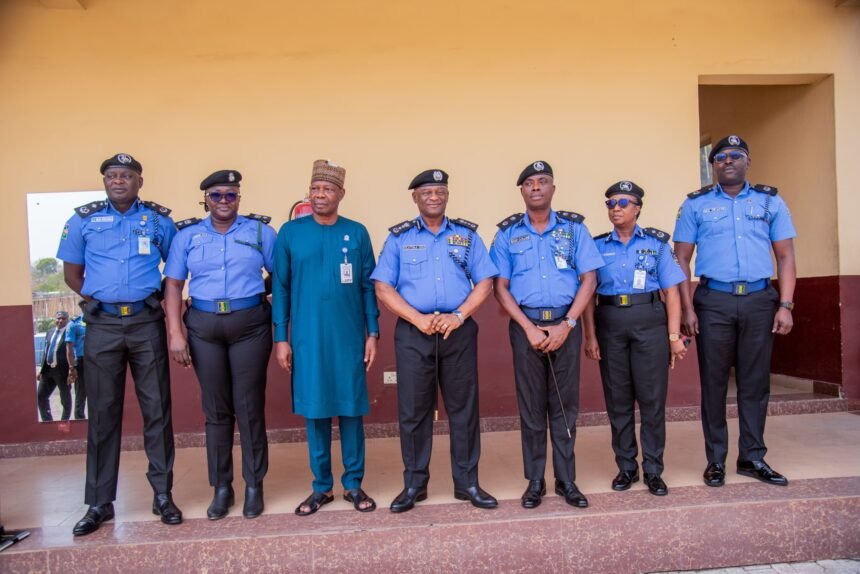
The Inspector-General of Police, Olatunji Rilwan Disu, has formally inaugurated a Steering Committee to develop a framework for the establishment of State Police in Nigeria, describing the move as a significant step toward strengthening the country’s internal security architecture.
The inauguration ceremony, held in Abuja, brought together senior police officers, stakeholders and invited guests. In his address, the IGP said the task before the committee was both “significant and timely,” as Nigeria continues to grapple with evolving security challenges requiring innovative reforms and strategic collaboration.
According to him, the concept of State Police is being carefully examined as part of broader national efforts to improve security governance, enhance community participation in crime prevention, and make policing more responsive to local realities.
The committee is chaired by Prof. Olu Ogunsakin, Director-General of the National Institute for Police Studies, Jabi, Abuja, with Commissioner of Police Bode Ojajuni serving as Secretary. Other members include DCP Okebechi Agora, DCP Suleyman Gulma, ACP Ikechukwu Okafor, CSP Tolulope Ipinmisho, and retired CP Emmanuel Ojukwu, Provost of the Police Public Relations School.
The IGP charged the committee with reviewing existing policing models within and outside Nigeria, assessing community security needs and emerging risks, and proposing an operational framework for the establishment and coordination of State Police structures.
He said the committee is also expected to address critical issues relating to recruitment, training standards, resource allocation, and to develop robust accountability and oversight mechanisms to ensure professionalism and public trust.
“If thoughtfully designed and effectively implemented, State Policing holds significant potential benefits for our country,” the IGP said, noting that bringing law enforcement closer to communities would deepen local knowledge of security dynamics and enable quicker, more targeted responses to threats.
He added that decentralising certain policing responsibilities would allow state governments and local authorities to respond more efficiently to specific security challenges, while the Federal Government focuses on broader national priorities.
The police chief emphasized that State Police should not be seen as a replacement for the Nigeria Police Force but as a complementary structure within a coordinated national security framework.
He explained that the Nigeria Police Force would continue to perform its constitutional role as the primary national law enforcement institution, particularly in tackling complex and transnational crimes such as terrorism, organised crime, cybercrime, and trafficking networks.
Under the proposed arrangement, State Police formations would concentrate on community safety, neighbourhood patrols, conflict prevention, and early response to emerging threats, fostering specialization and improved security outcomes.
The IGP reassured officers and men of the Force that their roles and professional relevance remain intact and indispensable, stressing that the vision is one of synergy and partnership rather than competition.
He urged members of the committee to approach their assignment with diligence, objectivity and patriotism, noting that their recommendations would guide policymakers in shaping a policing framework that upholds democratic values, the rule of law and accountability.
The Inspector-General thereafter formally declared the Committee on State Police inaugurated and wished members fruitful deliberations.