

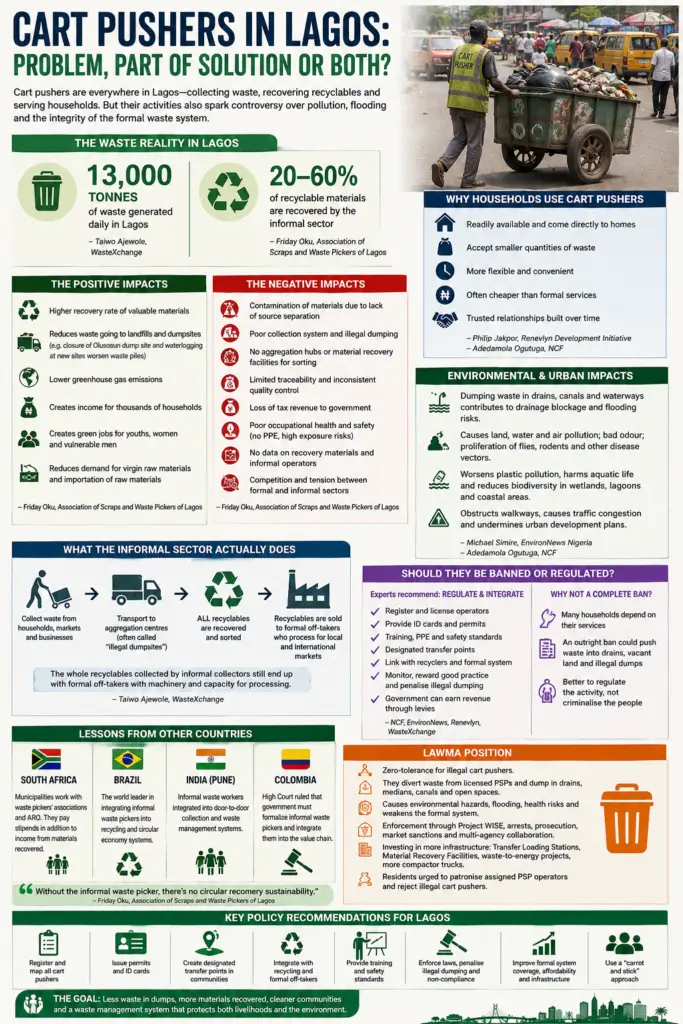
Cart pushers remain an important but controversial part of Lagos’ waste-management system, providing affordable and flexible services to households while also raising concerns over illegal dumping and environmental degradation.
Every day, hundreds of informal waste collectors move through neighbourhoods, markets and streets, picking up bottles, cartons, metals, plastics and other discarded materials that formal waste operators may not always reach.
For many residents, the operators provide a convenient way to dispose of household waste, while the activity also provides livelihoods for thousands of informal workers.
However, the Lagos Waste Management Authority (LAWMA) maintains a zero-tolerance policy toward illegal cart pushing, arguing that unregulated operators undermine the state’s formal waste-management system.
Environmentalists and circular-economy experts, however, say an outright ban could ignore the contribution of informal waste collectors to recycling and resource recovery.
Friday Oku, President of the Association of Scraps and Waste Pickers of Lagos, said informal waste pickers recovered a significant proportion of recyclable materials, although the exact figure for Lagos remained unclear due to inadequate data.
He said the sector recovered metals, cartons, nylon, aluminium and cans, but faced challenges including poor collection arrangements, inadequate aggregation centres, contamination and occupational safety risks.
Oku called for the establishment of mini-recycling collection hubs in communities and local government areas where waste pickers could sort and aggregate recyclable materials.
He also advocated formalising the sector through registration, identification cards, health insurance, social protection and fair pricing.
Similarly, Taiwo Ajewole, CEO of WasteXchange and a circular-economy expert, said cart pushers were filling a gap in Lagos’ waste-management system.
Ajewole said Lagos generated about 13,000 tonnes of waste daily, creating opportunities for informal collectors to recover recyclable materials.
He explained that materials collected by cart pushers eventually reached formal off-takers, which processed them for local and international markets.
Ajewole therefore urged the government to integrate informal collectors into the formal waste system rather than eliminate their activities, noting that proper regulation could also generate additional revenue for government.
Philip Jakpor, Executive Director of Renevlyn Development Initiative, said cart pushers remained popular because they were readily available and offered flexible services compared with formal operators working on fixed schedules.
He cautioned against blaming cart pushers alone for indiscriminate dumping, stressing the need for adequate disposal facilities and effective enforcement.
Environmentalist and publisher of EnvironNews Nigeria, Michael Simire, also acknowledged the role of informal collectors but warned that unregulated activities could contribute to traffic obstruction, illegal dumping and environmental problems.
He said some operators dumped waste in drains, canals and open spaces to avoid disposal costs, potentially worsening flooding.
Adedamola Ogutuga, Head of Environmental Education at the Nigerian Conservation Foundation, said the challenge was not necessarily the cart itself but what happened to the waste after collection.
She said properly regulated cart pushers could support the circular economy by collecting recyclable materials and delivering them to recognised recycling facilities.
Ogutuga recommended registration, identification cards, training, designated transfer points, partnerships with recycling organisations, safety standards and sanctions for illegal dumping.
LAWMA, however, said illegal cart pushers remained incompatible with Lagos’ regulated waste-management framework.
The authority said illegal operators divert waste from licensed Private Sector Participation operators and often dispose of waste at unauthorised locations, including road medians, drainage channels, canals and open spaces.
According to LAWMA, such practices increase environmental hazards, weaken the financial sustainability of formal waste management and discourage investment in modern waste-collection infrastructure.
The authority said some residents and businesses continued to patronise illegal operators, contributing to the persistence of the practice.
It said its Project WISE teams, in collaboration with other government agencies, had intensified advocacy, surveillance and enforcement, resulting in arrests and prosecutions.
LAWMA added that markets, commercial premises and other facilities found encouraging indiscriminate waste disposal could face compliance notices, sealing and prosecution.
The authority said it was also investing in Transfer Loading Stations, Material Recovery Facilities, waste-to-energy projects, expanded recycling initiatives and additional compactor trucks to strengthen the formal waste-management system.
The debate over cart pushers reflects a broader challenge facing Lagos, where rapid urbanisation, rising waste generation and recurring flooding intersect.
While residents value cart pushers for their affordability and convenience, and informal operators depend on the activity for their livelihoods, environmental experts say the sector must be brought under an effective regulatory framework.
The future of cart pushing in Lagos may therefore depend not on an outright ban or unrestricted operation, but on a transparent system that protects livelihoods, promotes recycling and prevents illegal dumping.