

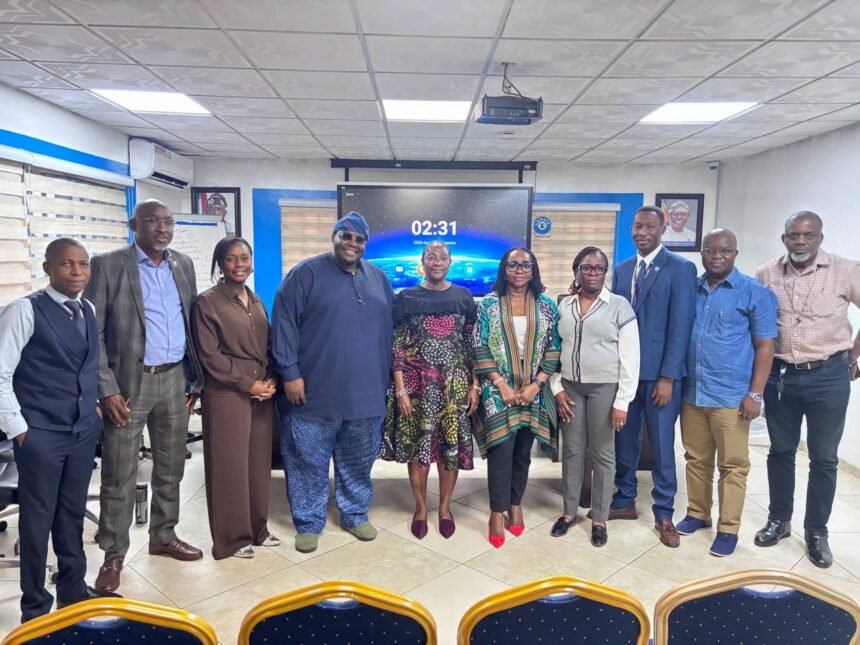
The Lagos Metropolitan Area Transport Authority (LAMATA) has reaffirmed its commitment to developing a sustainable, climate-resilient and data-driven mass transit system capable of reducing transportation-related carbon emissions across Lagos.
LAMATA Managing Director, Engr. Abimbola Akinajo, gave the assurance when she received a delegation from the Office of Climate Change and Circular Economy (OCCE), led by the Special Adviser to the Governor, Mrs. Titilayo Oshodi, at the Authority’s headquarters.
The meeting focused on strengthening collaboration between LAMATA and OCCE on climate-smart transportation, exploring carbon-financing opportunities and deploying reliable emissions data to support Lagos’ transition to cleaner urban mobility.
Akinajo said LAMATA’s growing portfolio of sustainable transport projects provides a strong foundation for advancing the state’s climate objectives while delivering efficient and affordable mobility to millions of residents.
She highlighted the Authority’s investments in electric and low-emission public transport, as well as the continued development of an integrated mass transit system, as evidence of Lagos’ commitment to linking transportation development with climate action.
According to her, reliable data will be essential for measuring the environmental impact of transport investments, identifying additional opportunities to reduce emissions and positioning Lagos to access emerging global climate-financing opportunities.
During the engagement, the OCCE delegation demonstrated the DecarbonIQ Intelligence Platform, a technology-based system designed to measure, monitor and manage carbon emissions across transport networks.
The platform provides emissions-reduction advisory services, enabling stakeholders to analyse transport-related emissions and identify opportunities for decarbonisation. It also offers a unified source of carbon data to support the tracking, validation and verification of emissions information.
The demonstration also highlighted the platform’s alignment with Article 6 of the Paris Agreement, which provides mechanisms for international cooperation on climate targets and creates opportunities for credible carbon markets.
Oshodi stressed the importance of establishing a verified single source of carbon data for Lagos, noting that transportation remains critical to the state’s climate ambitions amid increasing investments in electric mobility, rail transportation and other low-carbon mass transit solutions.
The meeting was also attended by Dr. Adebola Odunsi and other OCCE representatives.
Akinajo assured the delegation that LAMATA was ready to deepen its partnership with OCCE and other stakeholders to develop robust, data-driven frameworks for sustainable transportation.
She added that the Authority would explore innovative approaches that combine technology, credible data and sustainable infrastructure to improve mobility while reducing the environmental impact of transportation.
The collaboration is expected to strengthen Lagos’ ability to quantify the climate benefits of its mass transit investments, improve access to green financing and accelerate the transition to a cleaner and more resilient urban transportation system.