

Beneath the bustle and colour of Lagos lies an ancient tradition that transforms the city into a sea of white, as the Eyo Festival brings together history, spirituality, royalty and cultural memory.
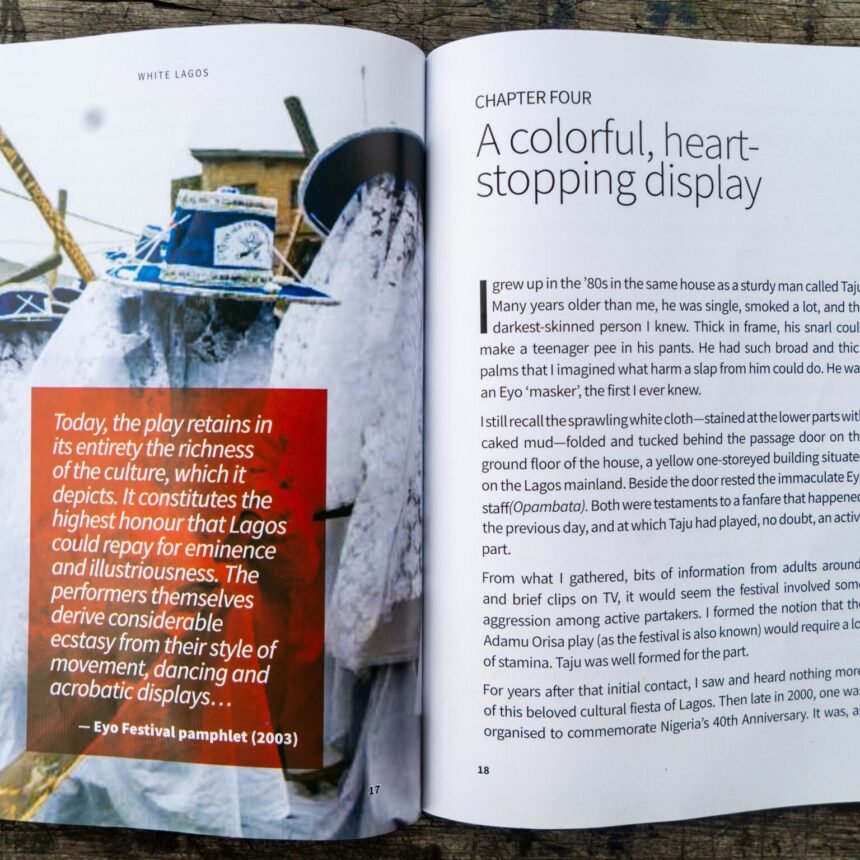
Travel journalist and author, Pelu Awofeso, explores the deeper meaning of the festival in his book, White Lagos, which has returned in a second edition with updated content and a new cover.
Awofeso began documenting the festival in 2003 when he covered the Eyo procession held in honour of the late Oba Adeyinka Oyekan II and the transition to a new Oba of Lagos.
Speaking at a reading of White Lagos during the opening of the Port City Reading Room in Apapa, Lagos, Awofeso said his experience of the festival inspired more than a decade of research, interviews and field documentation.
“Since 2003, I’ve seen about four Eyo festivals. I kept field notes, conducted interviews and collected every scrap of information I could. All of that became White Lagos,” he said.
The book was first published in 2017 as part of activities marking Lagos at 50. According to the Lagos State Commissioner for Information, Gbenga Omotoso, the first edition was sold out.
The new edition, unveiled at a programme hosted by Goge Africa, seeks to take readers beyond the spectacle of masked figures dressed in white flowing agbada, carrying staffs and moving through the streets of Lagos.
Awofeso said much of what makes the Eyo Festival significant happens long before the procession itself.
“Many people only see Eyo from a distance. They don’t know what happens behind the scenes—the months of divination, the rituals, the family negotiations and the daily steps that lead to that one grand day,” he said.
Unlike most cultural festivals, Eyo is not an annual event and is not organised simply as a tourism attraction. It is traditionally held in connection with the death of an important Lagosian, including a king, white-cap chief or other individual considered to have contributed significantly to the development of the city.
“Every time there is an Eyo Festival, it must be attached to someone who has died—a royal, a chief or a Lagosian who contributed to the growth and development of the city,” Awofeso explained.
He noted, however, that Eyo has occasionally been staged to honour living dignitaries or commemorate major events, citing Queen Elizabeth II’s 1956 visit to Lagos and FESTAC ’77 as examples. Even in such cases, tradition requires the festival to remain connected to a deceased figure.
Awofeso described the festival as an elaborate and expensive cultural undertaking, saying he was informed that the most recent edition cost the Lagos State Government about N10 billion.
“It is not a revenue-generating event. The government doesn’t earn from it; it spends on it,” he said.
He added that while the state may not directly generate revenue from the festival, small businesses such as fabric sellers, food vendors and other suppliers benefit from the economic activity surrounding the event.
The origins of Eyo remain subject to differing historical accounts, with some traditions tracing its beginnings to 1750 and others to 1854. Regardless of the disputed date, Awofeso noted that the festival has survived for centuries despite colonialism, modernisation and the rapid transformation of Lagos.
One of its most visible features is the participation of young people alongside elders, which Awofeso described as an important means of transmitting cultural memory from one generation to another.
“It’s a salute to the consciousness of the people. They are saying: this culture must not die. It was handed to us by our ancestors; we are determined to pass it on,” he said.
The distinctive white clothing of the Eyo masquerades is another defining feature of the festival. Awofeso said there is no clear documented explanation for the choice of white, although historical records indicate that the earliest Eyo masquerades were dressed in the colour.
He noted that the masquerades at one point wore Ankara fabrics, but the tradition eventually returned to white.
Within traditional religious symbolism, white is associated with purity, sacrifice and cleansing. The flowing, oversized garments worn by the masquerades therefore carry symbolic meaning beyond their visual appeal.
According to Awofeso, the Eyo procession is traditionally viewed as a form of spiritual cleansing, with the masquerades believed to sweep away evil, sickness and discord as they move through the community.
Dr Hope Orivri, a development communication specialist, journalist and Chief Executive Officer of Ports City Reading Room, described White Lagos as an important guide to understanding the Eyo Festival beyond its visual spectacle.
She said the book provides readers with an opportunity to explore the history, symbolism and cultural meanings associated with the festival.
Orivri noted that the book also examines differing accounts of Eyo’s origins, including one tradition linking it to the ancient Benin Kingdom and another tracing it to Ikorodu, north of Lagos.
Despite the differences, she said, the traditions share a central story involving a barren queen who, through traditional worship consistent with the beliefs of her people, eventually became fertile.
According to her, the story places fertility, birth and renewal at the heart of the festival, while Eyo’s links with royalty and transition further connect it to the passage of kings into the afterlife and, in some instances, the installation of new rulers.
Orivri described the festival as a ritual bridge between the physical and spiritual worlds and a living archive of Lagos’ cultural identity.
She said White Lagos serves both as an introduction for visitors and an invitation to Lagos residents to deepen their understanding of a tradition that remains central to the city’s heritage.
For Awofeso, the essence of the book is to reveal the story behind the spectacle.
“I wanted readers to understand that what they see on that single day is only the surface. There is a long journey before the drums start. This book is my way of opening that door,” he said.
In a city constantly reshaped by modernity, White Lagos documents a tradition that continues to connect generations, preserving the memory of the people through a procession of white, drums, rituals and remembrance.