

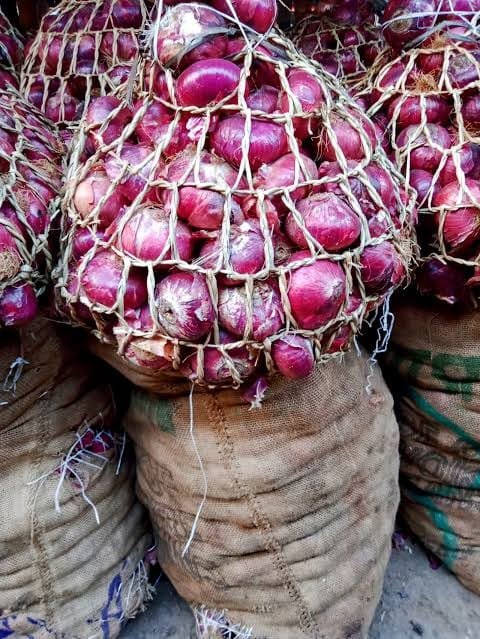
The price of onions has risen by more than 200 per cent in Lagos, leaving traders and consumers worried as the commodity becomes increasingly scarce and expensive.
A News Agency of Nigeria (NAN) survey showed that a bag of onions now sells for between ₦150,000 and ₦250,000, depending on the size and variety, compared with ₦50,000 to ₦70,000 in May.
Musa Muhammed, a wholesaler at Cole Street, Oyingbo, attributed the increase partly to the rising cost of transporting onions from northern Nigeria to Lagos.
He said scarcity in Sokoto and other northern states during the current planting season had also contributed to the price hike.
Muhammed added that flooding in major onion-producing states, including Sokoto, Kebbi, Zamfara, Kano, Kaduna, Katsina and Adamawa, had further affected supplies.
According to him, the cost of transporting a bag of onions has risen to about ₦30,000, excluding other transportation expenses to Lagos.
He said a paint bucket of onions that sold for about ₦3,000 in May now costs ₦10,000, forcing traders to increase their prices to cover rising costs.
Vivian Isoken, a consumer in Ijegun, Ikotun, blamed the high prices partly on inadequate agricultural machinery available to local farmers.
Another resident, Beatrice Oladiran of Agege, said the increase was also seasonal, explaining that onion supplies typically decline during the rainy season and planting period.
She added that rising fuel costs had further increased the cost of transporting agricultural produce.
Oladiran said a small bag of onions that sold for between ₦17,000 and ₦20,000 in March now costs between ₦60,000 and ₦70,000, making the commodity unaffordable for many households.
Traders also expressed concern about storage, with Usman, an onion seller at Oyingbo under-bridge, saying newer onions spoil easily and require proper ventilation to extend their shelf life.
Meanwhile, Mary Udonwa, a resident of Ajegunle, said she had reduced her consumption of onions because of the sharp increase in price.
She said she would resume her normal consumption when prices became more stable.