

Every morning, Dr Adamu Inusa checks his phone, hoping to find the email that will define the next phase of his medical career.
For 18 months, he has scanned the recruitment portals of federal teaching hospitals for a residency position, but the offer he worked for years to secure has yet to arrive.
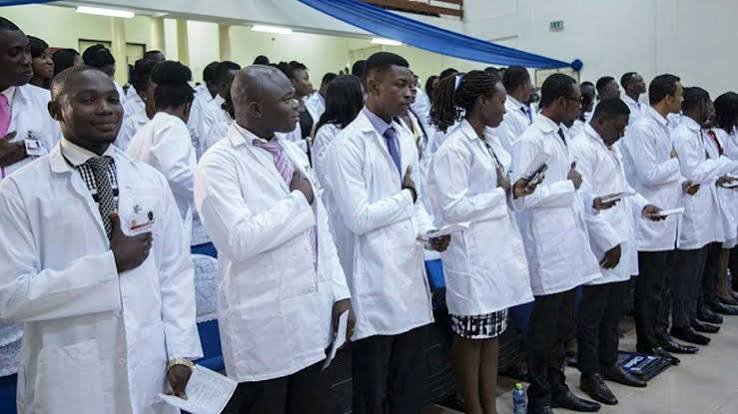
He spent six gruelling years in medical school, endured prolonged strike, and completed the one-year housemanship. After taking the Hippocratic Oath, he expected to begin building a career in Nigeria.
Instead, he works 12-hour night shifts as a locum doctor in a private clinic in the Federal Capital Territory (FCT), while struggling to meet his financial obligations.
“To keep from starving, I work 12-hour night shifts as a locum doctor at a makeshift private clinic in the FCT, earning less per hour than a rideshare driver, while treating complex cases without basic equipment,” he said.
Inusa’s experience is shared, to varying degrees, by other young doctors seeking specialist training after housemanship.
It exposes a less-discussed dimension of Nigeria’s health workforce crisis: the country is losing doctors to migration, while some qualified doctors who want to remain are unable to find a clear pathway into specialist training.
Data from the Nigerian Association of Resident Doctors (NARD) indicates the severity of the country’s doctor shortage, with the doctor-to-patient ratio remaining far below what is required to adequately serve the population.
Yet alongside the shortage is another contradiction: Nigeria has doctors who are qualified and available to work, but many face fierce competition for limited residency positions.
After medical school and housemanship, doctors can practise as general practitioners. Those seeking specialisation in paediatrics, surgery, oncology, orthopaedics, or anaesthesia must secure residency positions at accredited tertiary hospitals.
Residency is a critical stage in the medical career pathway. But passing the necessary examinations does not guarantee admission.
According to registry data from recent examination cycles, more than 900 Nigerian candidates sat for the West African College of Surgeons (WACS) primary examinations across major centres including Ibadan, Abuja and Enugu, with about 73 per cent recorded as successful.
Similarly, the National Postgraduate Medical College of Nigeria (NPMCN) regularly clears hundreds of general practitioners who are academically and professionally qualified to proceed with specialist training.
At major training institutions such as the Lagos University Teaching Hospital (LUTH) and University College Hospital (UCH), Ibadan, hundreds of doctors compete for positions across numerous specialities.
LUTH, for instance, opens applications across several specialised fields, including anaesthesia and maxillofacial surgery.
In highly competitive recruitment cycles, a single teaching hospital can receive between 400 and 600 applications from qualified doctors seeking residency positions.
However, experts say the number of available places could be dramatically smaller.
Because of budget ceilings, structural underfunding and stagnant departmental quotas, funded positions across specialities may be between 30 and 50.
In some departments, including paediatrics and orthopaedics, only two or three doctors may be admitted in an entire recruitment cycle.
Dr Judith Nalukwago, a dental surgeon who advocates for young medical professionals affected by health-sector funding cuts, said hundreds of qualified applicants could be turned away because there were simply not enough training places.
“The country needs more specialists, yet its major training institutions are often unable to absorb the doctors seeking to become those specialists,” she said.
Dr Mohammad Suleiman, National President of NARD, said the situation had created a serious mismatch between demand for healthcare and opportunities for young doctors to progress professionally.
“We have a situation where the demand for care is astronomical, yet young doctors are being locked out of training.
“When the system creates administrative bottlenecks around the Medical Residency Training Fund (MRTF) and slot allocations, it leaves brilliant minds completely stranded,” he said.
Doctors waiting outside the residency system must keep applying, paying examination and application fees, and looking for ways to survive while their professional progression remains uncertain.
A doctor may complete years of training, housemanship and professional examinations, yet access to postgraduate training can ultimately depend on whether a hospital has an accredited and funded vacancy.
Doctors may be qualified to practise as general practitioners while remaining unable to enter the specialist programmes they need to advance their careers.
The problem is therefore larger than unemployment in the conventional sense. It is a question of whether Nigeria’s medical education system, postgraduate training capacity and workforce planning are moving in the same direction.
Medical schools produce graduates; housemanshp prepares them for independent practice; residency develops the specialists Nigeria needs.
But when residency places fail to keep pace with the number of qualified doctors seeking them, a gap opens between graduation and professional advancement.
The Federal Government says it is investing in healthcare infrastructure, recruitment and workforce development.
The Minister of State for Health and Social Welfare, Dr Iziaq Salako, announced a N43 billion release for health-sector reforms, including N10.6 billion earmarked for the 2025/2026 MRTF.
Under the Nigeria Health Sector Renewal Investment Initiative, the government granted special recruitment waivers that added more than 20,000 healthcare personnel to the public-sector payroll.
Funding doctors already admitted into residency is different from creating additional accredited positions for doctors waiting outside the system.
With limited access to residency, some doctors turn to private facilities for locum work.
Stakeholders estimate that doctors working in parts of Lagos and Abuja may be earning between N80,000 and N150,000 monthly, depending on the facility, workload and number of shifts.
A clinical psychologist, Mr Phillip Dimka, said some private hospitals, aware of the desperation among young doctors, employed them on poor terms.
“Private hospitals, acutely aware of the desperation brewing in the medical community, recruit these overqualified general practitioners to run their entire facilities for a fraction of standard pay.”
Dimka said some doctors worked long shifts with inadequate equipment and limited access to consultant supervision.
“In these underregulated settings, young doctors face immense medical and legal risks,” he said.
Behind the statistics are graduates who invested years of their lives and significant family resources in becoming doctors.
Mr John Umoh, a civil servant and father of a 200-level medical student, said parents often sacrificed savings and other opportunities in the belief that their children would eventually become financially independent professionals.
“For some graduates, that expectation is delayed indefinitely. They continue to depend on ageing parents, struggle with rent and transportation, and accept whatever locum work is available,” Umoh said.
Mrs Martha Yohanna, a human resources manager, said the impact was also professional.
“Doctors who remain outside residency may continue to gain clinical experience through locum work, but they lack the structured progression, supervision and specialist development provided by formal training programmes.
“The longer they remain outside the system, the more difficult it can become to plan their careers. For a country already struggling to retain doctors, which represents another form of loss,” she said.
Stakeholders say the situation is worrisome as doctors continue leaving for the UK, the U.S., Canada and other countries in search of better opportunities.
Records indicate that more than 10,000 Nigerian-trained doctors are registered with the UK General Medical Council, while NARD has documented the continuing departure of resident doctors from Nigeria.
A doctor who cannot secure residency may eventually look abroad not because the desire to build a career has disappeared, but because the opportunity to build one at home has.
NARD has repeatedly linked migration to poor remuneration, difficult working conditions, manpower shortages and inadequate career prospects.
Dr Augustine Uchenna, a health entrepreneur, said the country needed accurate workforce projections showing how many doctors were graduating, entering housemanship and seeking residency, as well as how many specialists would be required.
“Recruitment processes must be transparent and predictable so that doctors understand how positions are allocated and why applications succeed or fail.”
He said private hospitals that depended heavily on locum doctors also needed stronger oversight to ensure temporary employment did not become a substitute for safe staffing and fair professional conditions.
“The objective should not be to force every doctor to remain in Nigeria. Rather, it should be to ensure that leaving is a choice, not the consequence of a system that has left qualified professionals with no viable route forward,” he said.
Recently, Inusa received information about registering for the Professional and Linguistic Assessments Board (PLAB) examination, a key requirement for doctors seeking to practise in the UK.
He said the message was not the residency offer he had been waiting for. It represented a different future.
It is about whether Nigeria can provide a professional future for someone it has spent years training.
For outside observers, Inusa’s departure from Nnamdi Azikiwe International Airport would likely be categorised as just another statistic in the country’s medical brain drain.
However, that label oversimplifies his journey. Leaving wasn’t his initial goal; his first instinct was to find a reason to remain in Nigeria.
This highlights the true gravity of the nation’s healthcare workforce crisis.
Analysts say Nigeria is not just losing doctors to only active emigration—it is losing them because systemic delays leave them waiting so long that departure becomes their only viable path forward.