

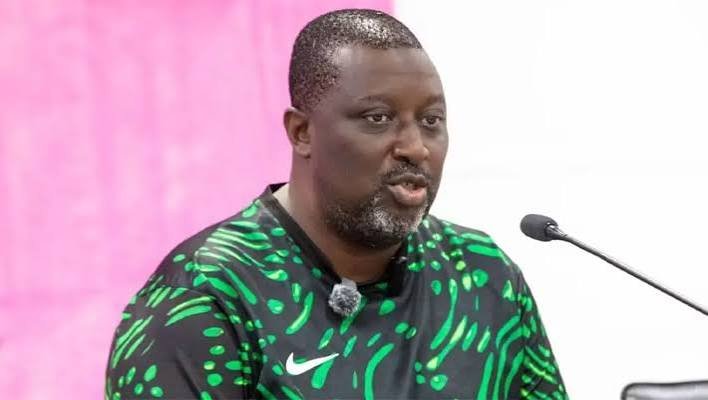
By Suara Sherif
Years of coaching education, professional experience and persistence culminated in a historic achievement as the Lead City University graduate guided Nigeria’s Flamingos to their first FIFA U-17 Women’s World Cup title within seven months of his appointment.
Behind Nigeria’s historic triumph at the 2026 FIFA U-17 Women’s World Cup is a story of professional preparation, experience and an opportunity that eventually transformed into a defining moment in African football.
At the centre of that story is Akeem Ishola Busari, the Nigerian tactician whose remarkable journey from domestic football to the international stage culminated in leading the Flamingos to their maiden world title in Morocco.
His achievement, however, did not begin with his appointment to the national team in April 2026. It was the product of years of coaching education, professional engagements and experience across different levels of Nigerian football.
A graduate of Lead City University, Ibadan, Busari belongs to the institution’s 2012 Enterprise Class, where he obtained a Bachelor of Science degree in Physical and Health Education.
His academic background provided an important foundation for his professional involvement in sports, but his coaching development had already begun years earlier.
According to information provided by the National Institute for Sports (NIS), Busari obtained his initial coaching qualification at the institute in Lagos in 1999. He subsequently returned for higher-level programmes between 2003 and 2006, with his final coaching certificates issued in October 2006.
The training represented an important investment in his technical development, equipping him with professional knowledge that would become increasingly relevant as he progressed through the football coaching environment.
Rather than arriving at the national assignment without experience, Busari had spent years building the technical foundation required for the responsibility.
Busari’s professional journey took him through several Nigerian football establishments, where he accumulated experience in both men’s and women’s football.
His coaching engagements included Shooting Stars, Gateway United, JSP FC and Bayelsa Queens, alongside experience in the Republic of Benin.
These assignments exposed him to different competitive environments and the demands of managing players, organising teams and developing football structures.
Before his national-team appointment, he was the head coach of Pacesetter Queens FC of Ibadan, a position that placed him within the domestic women’s football environment.
His experience in the women’s game was particularly relevant to the new responsibility awaiting him, as he had developed an understanding of the Nigerian women’s football landscape before being entrusted with the country’s U-17 national side.
On April 2, 2026, the Nigeria Football Federation (NFF) announced Busari’s appointment as head coach of the Flamingos.
He succeeded Bankole Olowookere, who had guided Nigeria to a bronze-medal finish at the 2022 FIFA U-17 Women’s World Cup in India.
The appointment represented a significant career opportunity and came with an immediate responsibility: securing Nigeria’s qualification for the 2026 tournament in Morocco.
Busari wasted little time in beginning preparations. Eight days after his appointment, the NFF announced that he had invited 36 players to camp ahead of the qualifying campaign.
The selection comprised five goalkeepers, 10 defenders, 13 midfielders and eight forwards, reflecting the early stages of assembling a competitive squad for the demanding assignment.
He also worked with a reconstituted technical crew, with the NFF confirming additional appointments to strengthen the team’s backroom structure.
One of Busari’s first major tests was navigating the Flamingos through the African qualification series.
Nigeria faced the Benin Republic in the decisive qualifying round, winning the first leg 3–2 in Ikenne before completing an impressive 5–3 victory in Lomé.
The 8–5 aggregate triumph secured the Flamingos’ place at the World Cup in Morocco.
Qualification was an important early milestone, but it also meant that the coaching staff had to shift attention towards preparing a young squad capable of competing against some of the strongest youth teams in international women’s football.
With the World Cup ticket secured, attention turned to player development, tactical organisation and final squad selection.
The NFF subsequently announced another phase of preparations, with 26 players invited to the team’s final camping programme in Abuja in August.
Busari and his technical crew eventually settled on a 21-player squad for the tournament, which commenced on October 17, 2026.
The preparations culminated in Nigeria’s departure for Morocco, where the Flamingos were expected to compete against some of the world’s leading youth football nations.
Nigeria’s campaign did not begin as planned.
The Flamingos suffered a 2–1 defeat to Poland in their opening group fixture, immediately placing pressure on the team to recover and demonstrate the resilience necessary to remain competitive.
However, the defeat did not derail their ambitions.
Nigeria responded with a 2–0 victory over Puerto Rico before recording an impressive 3–1 win against defending champions North Korea.
The results restored confidence and secured the team’s progression into the knockout rounds.
The Flamingos subsequently defeated Mexico 2–1 in the round of 16 and overcame Venezuela 1–0 in the quarter-finals to reach the last four.
The semi-final encounter against Brazil proved to be one of the defining moments of Busari’s World Cup campaign.
Nigeria produced an outstanding performance to defeat the South Americans 3–1, becoming the first African team to reach the final of the FIFA U-17 Women’s World Cup.
Beyond the result, the encounter highlighted Busari’s willingness to trust players based on their readiness and performance.
Awawu Bashiru, who had largely featured as a substitute earlier in the competition, was handed a starting opportunity against Brazil.
She responded with two goals, justifying the coach’s decision and demonstrating the importance of squad depth and effective player management.
Speaking after the semi-final, Busari acknowledged the quality of the Brazilian opposition and praised his players for their courage, discipline and collective effort.
He also emphasised the importance of encouraging young players and helping them understand what was required to reach the final.
The journey reached its defining moment on November 7, 2026, when Nigeria faced Japan in the final in Rabat, Morocco.
The Flamingos approached the encounter with confidence and determination, eventually securing a 2–1 victory to claim their first-ever FIFA U-17 Women’s World Cup title.
Awawu Bashiru opened the scoring in the 39th minute, before Oluebube Umejiaku extended Nigeria’s advantage shortly after the restart.
Japan later reduced the deficit, but the Nigerian team maintained its composure to protect the lead and secure the historic victory.
Umejiaku’s outstanding tournament performances also earned her the Golden Ball award as the competition’s best player.
The triumph marked a significant departure from Nigeria’s previous best performance in the competition, a bronze-medal finish in 2022, and established the country as the first African winner of the tournament.
From his appointment on April 2 to the final on November 7, Busari spent approximately seven months and five days in charge of the Flamingos before delivering one of the most significant achievements in Nigerian youth football.
His journey illustrates how professional preparation, accumulated experience and the effective use of an opportunity can combine to produce an extraordinary outcome.
In his post-tournament comments to FIFA, Busari described the triumph as a turning point for African youth football, expressing optimism about the continent’s growing competitiveness on the international stage.
For the coach, the Moroccan triumph represents the culmination of years of professional development and the beginning of a new chapter in his career.
From his coaching education at the National Institute for Sports to his academic journey at Lead City University, his experiences across domestic football and his eventual appointment to the Flamingos, each stage contributed to the achievement that has now placed his name in Nigerian and African football history.
His story is ultimately one of preparation meeting opportunity, with the historic World Cup triumph serving as the most remarkable chapter yet.