

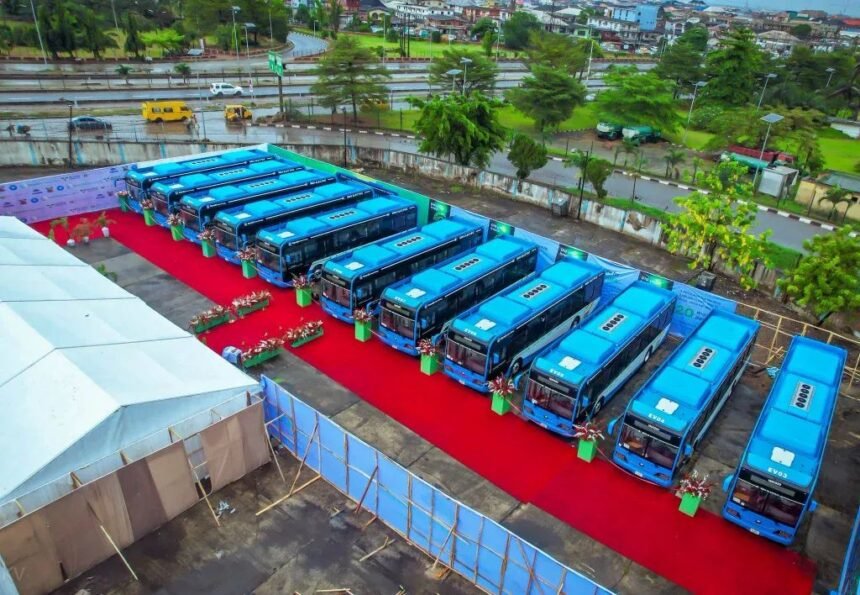
The Lagos State Government has unveiled 11 new electric buses as part of its efforts to promote cleaner and more sustainable public transportation across the state.
The buses, supplied by Oando Clean Energy Limited under the regulation of the Lagos Metropolitan Area Transport Authority (LAMATA), represent the first batch of a 50-bus commitment under the current phase of the partnership.
The initiative is expected to culminate in the deployment of 552 electric buses across public transport corridors in Lagos.
The Commissioner for Transportation, Oluwaseun Osiyemi, said the transition to cleaner energy was necessary to meet the growing transportation needs of the state amid increasing population and economic activities.
He noted that the government was committed to building a transport system driven by sustainability, energy efficiency, innovation and environmental responsibility, in line with its ambition to achieve net-zero emissions by 2050.
The Managing Director of LAMATA, Abimbola Akinajo, described the unveiling as a significant milestone in the state’s partnership with the private sector to modernise public transportation.
According to her, electric buses offer environmental benefits, including reduced greenhouse gas emissions, improved air quality and lower noise pollution.
She said the partnership with Oando was translating the shared vision of cleaner transportation into practical results.
Also speaking, the President and Chief Executive Officer of Oando Clean Energy Limited, Ademola Ogunbanjo, described the development as a defining moment for electric mobility in Nigeria and Africa.
He explained that the project was not merely about introducing electric buses but about establishing a sustainable mobility ecosystem that could be replicated across the country and the continent.
Ogunbanjo recalled that the partnership began with the signing of a Memorandum of Understanding between LAMATA and Oando in April 2022, followed by the deployment of two pilot electric buses in 2023.
He said the pilot phase provided an opportunity to test the technology, assess its operational resilience and environmental impact, and evaluate public acceptance before expanding the initiative.
Beyond supplying buses, he disclosed that Oando was working towards establishing a comprehensive domestic electric mobility ecosystem involving charging infrastructure, maintenance facilities, technical manpower development, spare-parts supply chains and eventual local vehicle assembly.
The project is supported by financial and technical partners, including the Bank of Industry, Wema Bank and Yutong, while prospective funding partnerships are being explored with the Africa Finance Corporation and the International Finance Corporation.
Ogunbanjo expressed confidence in the project’s prospects, saying the experience in Lagos could provide a model for electric mobility development across Nigeria.
The latest deployment is expected to provide additional operational experience ahead of the planned expansion of the electric bus fleet and support Lagos State’s broader climate action and sustainable transportation objectives.