

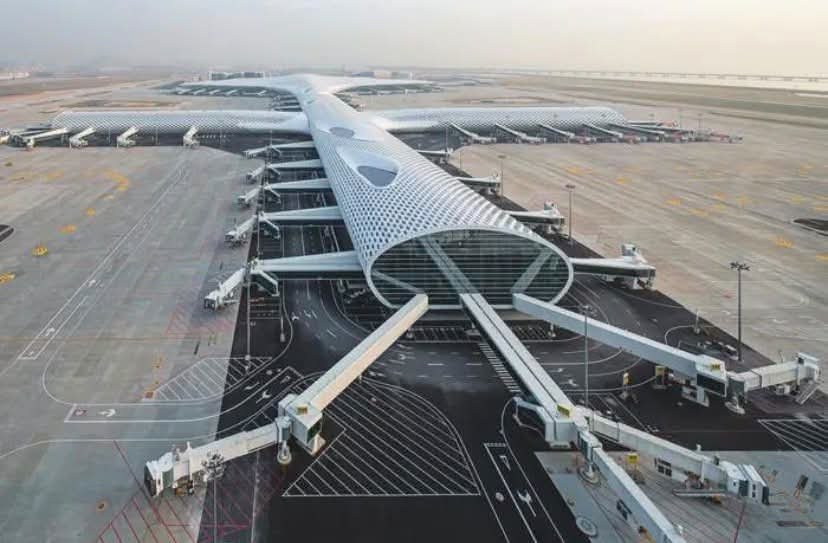
The Lagos State Government has set 2027 as the target year for the commencement of construction of the proposed Lekki-Epe International Airport, a major aviation project expected to transform connectivity and accelerate economic activities along the state’s rapidly developing Lekki-Epe corridor.
Governor Babajide Sanwo-Olu announced the timeline, signalling the state’s ambition to expand its aviation infrastructure and establish another international gateway to complement the existing Murtala Muhammed International Airport in Ikeja.
The proposed airport will occupy approximately 3,500 hectares of land along the Lekki-Epe corridor, with its first phase estimated to cost $900 million. According to the Lagos State Government’s 2025–2027 fiscal document, the initial development is designed to accommodate about five million passengers annually.
The project is being pursued under a Public-Private Partnership (PPP) arrangement. In February 2025, the state government signed a Memorandum of Understanding with Summa Group for the development and construction of the airport.
Beyond its passenger terminal, the proposed facility will feature cargo-handling infrastructure, aircraft parking aprons, runways, taxiways, air traffic control facilities, navigational aids, airfield lighting, baggage-handling systems, security surveillance and aircraft ground-support facilities.
One of the project’s major selling points is its planned compliance with Code F aviation specifications, which would enable it to accommodate some of the world’s largest commercial aircraft, including the Airbus A380.
The specification reflects the ambition to develop a modern international airport capable of supporting large-scale passenger and cargo operations.
The choice of the Lekki-Epe corridor is also strategic, given the concentration of major industrial and commercial investments in the area. These include the Dangote Refinery, Lekki Deep Sea Port and Lekki Free Trade Zone, which are positioning the corridor as one of Nigeria’s emerging centres of industrial production, maritime trade and international commerce.
An international airport in the area could provide investors, business executives, tourists and other international visitors with more direct access to these facilities while strengthening connections between aviation, maritime transportation and industrial logistics.
The airport is also expected to ease some of the operational and passenger traffic pressures on Murtala Muhammed International Airport, which currently serves as Lagos’s principal international aviation gateway. Its location in the eastern part of the state would improve access to air transportation for residents, businesses and investors across Lekki, Epe and neighbouring communities.
Beyond aviation, the project is expected to generate significant economic opportunities through construction, engineering, aviation operations, cargo management, hospitality, transportation, aircraft maintenance and other supporting services.
Its development could also stimulate investments in hotels, logistics parks, warehousing facilities, commercial properties and other businesses around the airport corridor, creating additional economic activities and employment opportunities.
For Lagos, the proposed airport represents more than an expansion of its aviation infrastructure. It is part of a broader strategy to integrate the state’s growing industrial, maritime, commercial and tourism sectors while strengthening its position as a leading investment destination in Africa.
However, achieving the 2027 construction target will require sustained attention to project financing, regulatory approvals, environmental assessments, land development and other critical implementation requirements.
If successfully executed, the Lekki-Epe International Airport could become a major aviation and logistics hub, opening up new economic opportunities for Lagos and reinforcing Nigeria’s capacity to compete in international trade, tourism and aviation.