

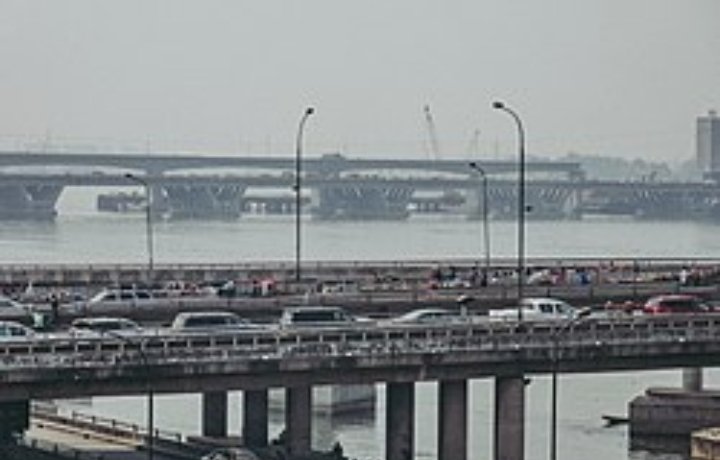
The Federal Government is reviewing a proposal to replace the ageing Carter Bridge in Lagos with a modern N320 billion cable-stayed structure—deemed more durable and cost-effective than the N380 billion required for full-scale repairs.
Carter bridge is the first bridge that connects the mainland to the island through Oyingbo-Iddo-Lagos Island.
Minister of Works, Senator Dave Umahi, disclosed this on Friday during an inspection of the bridge, accompanied by engineers from the ministry.
Umahi revealed that while Julius Berger has completed 80% of above-water repairs, fresh investigations uncovered severe underwater damage, including corroded piles and detached caps—issues similar to those that prompted truck restrictions on the Third Mainland Bridge.
He added that structural assessments conducted in 2012 and 2019 had already flagged these dangers. According to him, a newly constructed bridge could serve for over 100 years and still cost less than a comprehensive rehabilitation of the existing structure.
“The Federal Government has expressed worry at the state of the Carter Bridge in Lagos State, saying that its condition is dangerous and requires urgent attention,” read a statement from the News Agency of Nigeria (NAN).
It continued: “Umahi said the proposal to repair the Carter Bridge and connecting ramps was estimated at over N380 billion, while building a new cable-stayed bridge would cost about N320 billion.”
Currently, only two firms are involved in Lagos’ ongoing federal bridge rehabilitation projects: BuildWell on the Third Mainland Bridge and Julius Berger on Carter Bridge. Umahi confirmed that both proposals are under review and the ministry will submit its recommendations to President Bola Tinubu for final approval.
Julius Berger’s Regional Manager for the South West, Thomas Christe, noted that the firm began work on the Carter Bridge in 2024, focusing on handrails and above-water pile caps. However, he acknowledged the severity of underwater deterioration and clarified that the current contract does not include the full restoration scope.
“After our investigations, we suggested that a full replacement might be better,” Christe said. “A new bridge will last up to 100 years, and international investors are ready to help finance it.”
Umahi stressed the importance of addressing the bridge’s structural foundation rather than relying on superficial repairs, stating that the Carter Bridge now requires either deep structural intervention or outright replacement.