

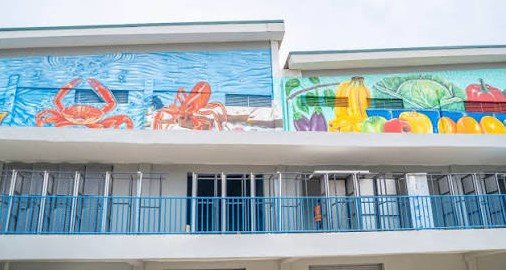
The Lagos State Government has inaugurated the Agege Fresh Food Hub at Pen Cinema to reduce post-harvest losses, improve food distribution and strengthen food security across the state.
The facility, commissioned on Wednesday, is the third Mid-Level Agro-Produce Hub in Lagos, following the Mushin hub, commissioned in December 2023, and the Abijo hub, commissioned earlier this year.
Speaking at the event, Gov. Babajide Sanwo-Olu said the hub was part of the state’s broader Food Systems Transformation Agenda, designed to make food supply more efficient, affordable and resilient.
He said Lagos, with a population of more than 25 million, depends heavily on food produced outside the state, with over 70 per cent of its food travelling through fragmented supply chains. According to him, this contributes to high transportation costs, post-harvest losses, poor storage, supply disruptions and price volatility.
Sanwo-Olu said the government was therefore transforming the food chain from production and aggregation to logistics, processing and retail.
He disclosed that the Mushin hub had recorded more than ₦4 billion in transactions across 228 market days, registered over 850 vendors and created more than 7,000 direct and indirect jobs.
The governor said Agege would now join the network, while similar projects were being developed at Opebi and Bombata. He added that locations had also been identified in Ikorodu, Apapa, Festac and the Lekki axis.
“Our long-term objective is clear: to establish structured food hubs across every Local Government and Local Council Development Area of Lagos State,” he said.
The Commissioner for Agriculture and Food Systems, Abisola Olusanya, said the Agege hub was designed around a hub-and-spoke model to improve the movement of food across Lagos.
She said the facility would address challenges including poor storage and handling, congestion, inefficient loading and offloading, waste management and inadequate trading conditions.
According to Olusanya, the hub occupies about 7,000 square metres, with a 4,000-square-metre trading floor capable of accommodating 350 to 400 vendors.
It also has 1,200 square metres of dry storage with a capacity of about 800 metric tonnes, alongside 300 metric tonnes of cold storage capacity. The facility includes an expanded seafood section, parking for 80 to 90 vehicles and 10 electric vehicle charging points.
The hub is projected to facilitate more than ₦5 billion in food transactions annually.
Olusanya said full operations would begin in six weeks after the completion of operator onboarding and the establishment of the necessary logistics and governance systems.
She said the facility would connect farmers, aggregators, processors, suppliers and bulk dealers with commissioned agents, retailers and institutional buyers, while providing better storage, quality control, inventory management, sanitation and waste management.
The commissioner added that the hub would help farmers access organised demand, reduce distress sales, improve incomes and encourage greater investment in agricultural production.