

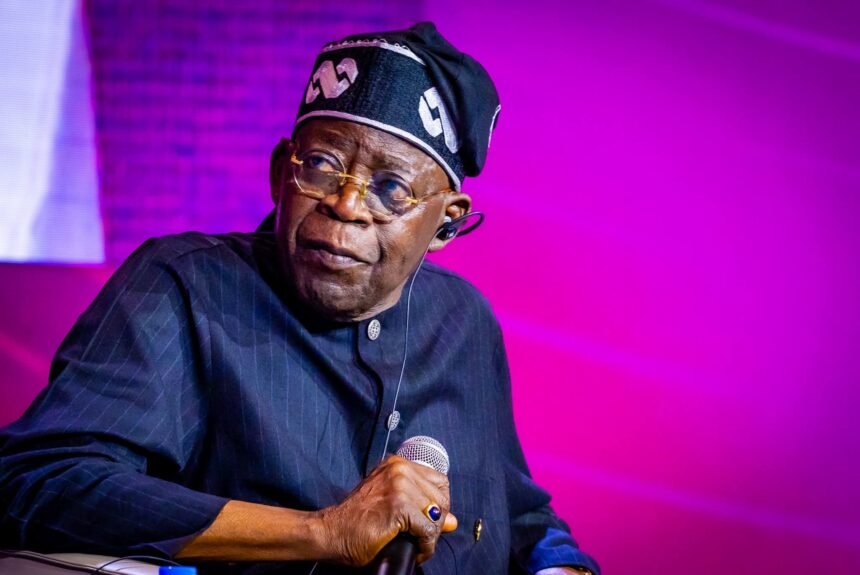
Former presidential spokesperson Laolu Akande has recounted what he described as years of political marginalisation suffered by President Bola Tinubu, saying the Nigerian leader endured being sidelined by powerful political figures before eventually securing the presidency in 2023.
Akande, who served as spokesperson to former Vice-President Yemi Osinbajo, said he personally witnessed occasions when Tinubu was relegated to the background during political meetings, despite his influence and contributions to the political movement that brought the All Progressives Congress (APC) to power.
Speaking about Tinubu’s political journey, Akande argued that the President’s ability to withstand setbacks, remain patient and organise strategically distinguished him from other politicians seeking the country’s highest office.
“What did they not do against President Tinubu? Tell me. What did they not do before 2014, 2015, and even between 2015 and 2023? He was marginalised. I saw it with my own eyes,” he said.
The former presidential aide added that he was present at meetings where Tinubu was allegedly denied the recognition and prominence he deserved.
“I sat in meetings where they put President Tinubu behind me. They marginalised the man,” Akande said.
According to him, rather than allow the alleged treatment to derail his political ambition, Tinubu remained focused on his long-term objective and waited for an opportunity to advance his presidential aspirations.
“You know what he did? He just waited. He waited for his time,” he added.
From power broker to president
Tinubu’s emergence as President followed decades of political activity, beginning with his involvement in pro-democracy politics and subsequent tenure as Lagos State governor from 1999 to 2007.
He later became a prominent leader of the Action Congress of Nigeria, one of the political parties that participated in the formation of the APC in 2013.
The merger brought together several opposition forces seeking to end the PDP’s dominance of the presidency. The coalition achieved that objective in 2015 when Muhammadu Buhari defeated incumbent President Goodluck Jonathan.
However, the emergence of a new governing party also brought competing interests and struggles for influence among its political leaders.
Tinubu eventually secured the APC presidential ticket in June 2022, defeating several contenders, including Osinbajo and former Transportation Minister Rotimi Amaechi.
He went on to defeat former Vice-President Atiku Abubakar of the Peoples Democratic Party and Labour Party candidate Peter Obi in the February 2023 presidential election.
For Akande, Tinubu’s rise illustrates the importance of patience and political organisation in a system where alliances, internal party rivalries and shifting power dynamics can determine the fortunes of individual politicians.
Akande recalls naira redesign controversy
Akande also cited the controversial naira redesign policy introduced by the Central Bank of Nigeria under former President Buhari as an important episode in Tinubu’s 2023 presidential campaign.
The policy involved replacing the old ₦200, ₦500 and ₦1,000 banknotes with redesigned versions. Its implementation triggered widespread cash shortages, disrupted commercial activities and generated public anger in the weeks preceding the general election.
Tinubu publicly opposed aspects of the policy, arguing that its implementation was causing hardship. The dispute also became entangled in the political contest ahead of the election, with the APC presidential candidate and his allies challenging the policy.
Akande said Tinubu responded to the unfolding events by mobilising his political structures and positioning himself to navigate the challenges.
“He acted; he organised. That is what Atiku has failed to understand. And that’s why it’s so painful,” he said.
His remarks drew a distinction between Tinubu’s approach to political adversity and that of Atiku, who contested the 2023 presidential election against him.
Atiku has remained a central figure in opposition politics since the election, while Tinubu has continued to lead the APC-led Federal Government.
Akande’s comments underscore the role of political networks, preparation and strategic timing in Tinubu’s journey from a powerful opposition figure to the presidency.
His account also offers a perspective on the internal tensions that have shaped Nigeria’s ruling political establishment over the past decade, although the specific meetings and incidents he referenced were not detailed in the quoted remarks.