
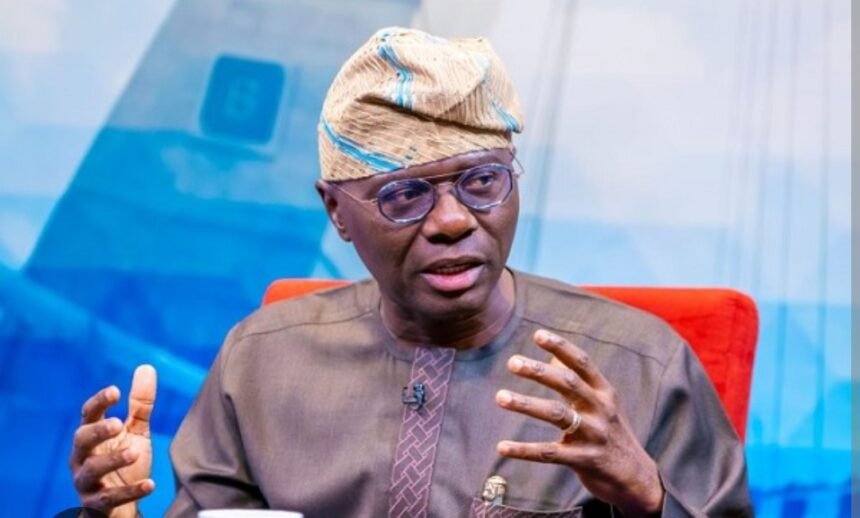
Lagos State Governor Babajide Sanwo-Olu has accused politicians in Abuja of resisting the state’s demand for special status, arguing that its historical significance and economic contributions warrant special consideration from the Federal Government.
Sanwo-Olu spoke at the Financial Times Africa Summit in London at the weekend, where he acknowledged the Federal Government’s support for Lagos but said more could be done to address the state’s unique challenges.
The governor said Lagos, which served as Nigeria’s former capital and remains the country’s commercial hub, deserved to be treated differently from other states.
“It’s an ongoing conversation. I cannot pretend that the current federal government is not helping out,” he said.
“Lagos used to be the capital of the country and the administrative head until when Abuja came up. So, they are helping but it could be a bit more.”
He said successive discussions on granting Lagos special status had encountered resistance from politicians in Abuja, despite the state’s national significance and diverse population.
“We have talked about Lagos being given a special status but constitutionally, the politicians in Abuja will never let that happen. So, we are having conversations,” he said.
Sanwo-Olu added that Lagos was home to people from different ethnic groups across Nigeria, making its circumstances distinct from those of other states.
“We are one of 36 states but they just need to look at us very differently because indeed, every single ethnic national have a place in Lagos,” he said.
The governor, however, expressed optimism that ongoing discussions with the Federal Government could yield results, noting that such changes required political negotiations and time.
He also called for a review of the distribution of Value Added Tax revenue, arguing that Lagos generates a significant proportion of the VAT collected nationally.
“Also, a lot of the VAT that is distributed nationally gets collected from Lagos. We are having some discussions about ensuring that Lagos still continues to earn more on value added taxation,” he said.
On infrastructure, Sanwo-Olu cited the Lagos section of the Lagos-Calabar Coastal Highway as evidence of Federal Government support.
He said the 70-kilometre stretch of the coastal highway in Lagos was largely completed and would improve connectivity between the state and other parts of the country.
The governor also highlighted the proposed Sokoto-Badagry Superhighway, particularly its planned network of 250 dams, which he said could boost irrigation and agricultural production, helping to improve food supplies to Lagos.
On electricity, Sanwo-Olu praised reforms introduced under President Bola Tinubu’s administration, saying they had created opportunities for states to participate more actively in power generation and distribution.
He said Lagos had established its electricity regulatory commission and signed about 22 public-private partnership agreements aimed at increasing power generation capacity by 2,000 megawatts within three years.
The governor also expressed hope that ongoing discussions on state policing would lead to a constitutional amendment allowing states to play a greater role in maintaining security.
According to him, the proposed reform would strengthen public safety and help create a more favourable environment for economic activities.