

By Iyene Mercy Etim
I was born, bred and buttered in Ajegunle, and absolutely nothing gives me more joy than the amazement of taxi drivers when I take a trip down to see my mum and they can’t believe we have so many good roads. Not just express roads—in roads, streets.
In their mind, how does this “ghetto” get so much infrastructure, and yet all the highbrow areas in Lagos State struggle with roads?
But Ajegunle wasn’t always like this.
I remember vividly the mountain of trash that used to stretch from Achakpo Road to New Road. Those days, we had our church around Ora Street, and we lived on the other side of AJ, Ojo Road. And because my mother is an Ibibio woman who loved her church, attendance was not optional; it was a full schedule. Monday choir rehearsal, Tuesday junior choir rehearsal (where I served as choir mistress for years), Wednesday Bible study, Thursday faith clinic, Friday prayer meeting, Saturday rehearsal, and then Sunday service. That route was our life.
During the day, we had to deal with the tedious hiking, the barrage of trash, and the stench. But at night, those same roads were pregnant with additional problems; they were a den of thieves. I cannot count how many times my brothers were robbed. One time, my brother was beaten on that route by thieves when he refused to relinquish his phone, or how many times we would just start running after night vigils like our lives depended on it—because they did.
Then one day, everything changed.
The government led by Fashola came in and cleared that mountain of trash. To this day, I struggle to explain how it happened so quickly. Work went on at a pace I had never seen before, and those heaps of waste, so high they almost touched electric poles, disappeared. Just like that, a major part of Ajegunle’s story began to shift.
Since then, Ajegunle has seen a lot of changes. Sometimes, it even feels like the Babajide Sanwo-Olu administration wakes up every morning with Ajegunle especially on its mind. The difference is not just visible—it is felt in everyday life. Roads have been rehabilitated and opened up, making movement easier. Drainage systems have improved, reducing the kind of flooding we once accepted as normal. Public schools are being upgraded, and healthcare access has improved with better-equipped primary health centres. Street lighting has come on stronger, and security presence has become more consistent.
Because the truth is, insecurity used to be a real fear here. There was a time some small boys would wake up early in the morning attacking people with axes, and in the evenings, shops would be forcefully shut down in chaos. But today, that kind of nonsense has largely been wiped out, and in its place is a growing sense of order, safety, and dignity. Even waste management tells its own story—the whole state can be complaining about irregular collection, and I will call my mum to gist, and she will simply say she cannot relate.
These changes have not just improved the environment—they have quietly shifted the value of the place. House rent in Ajegunle is now higher than places like Egbeda, Ikotun, Mushin, and Agege. I’m not even sure how I feel about that yet… but let me not digress.
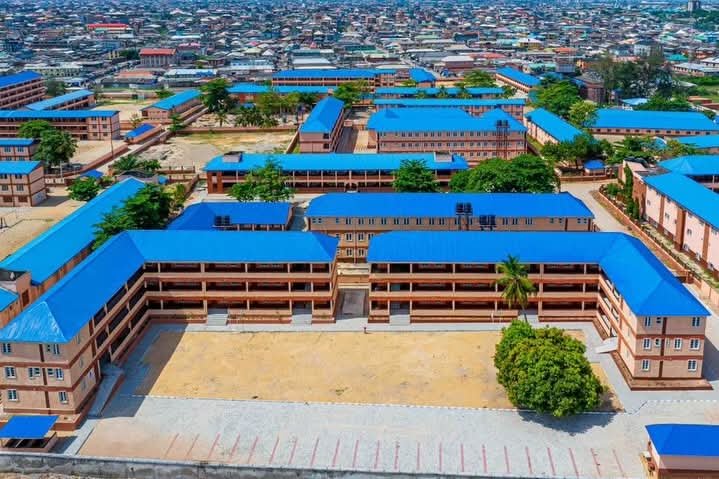
All of this is why, when I heard that the Tolu Schools Complex had been fully regenerated, I wasn’t very surprised, but I will not lie—it filled me with a deep sense of joy, pride, and quiet victory.
There is no need to bore you with the 1981 Tolu Complex story… but the commissioning of the fully regenerated Tolu Schools Complex is more than an upgrade—it is a restoration of dignity.
Honestly, you don’t need statistics to feel it. Just walk in and you’ll know. Everything is designed so a child’s body can relax and the mind can open up—no discomfort, no struggle, just a place to thrive.
Now, these children won’t have to “manage” as much. They can truly focus. They can explore. There’s a vocational centre where they can learn hands-on skills and begin to shape their own paths early. Science labs that bring learning to life, where they can see, touch, and test. And an ICT hub that connects them to a world far beyond Ajegunle without ever leaving.
This is for us. For teachers who stayed and refused to go to japa. For students, a quiet confidence that comes from knowing their environment is finally working for them, not against them, and it is giving parents peace of mind.
And for people like me, it is deeply emotional. Because Ajegunle, like me, has always had the talent, always had the drive, always had that stubborn resilience that refuses to break. What we are seeing now feels like Babajide Sanwo-Olu has finally decided to match that strength with structure—and that changes things.
So yes, this is about new buildings, but it is also about new possibilities. It is about a generation that will grow up seeing better and, more importantly, believing they deserve better. And sometimes, that belief is where everything begins.