
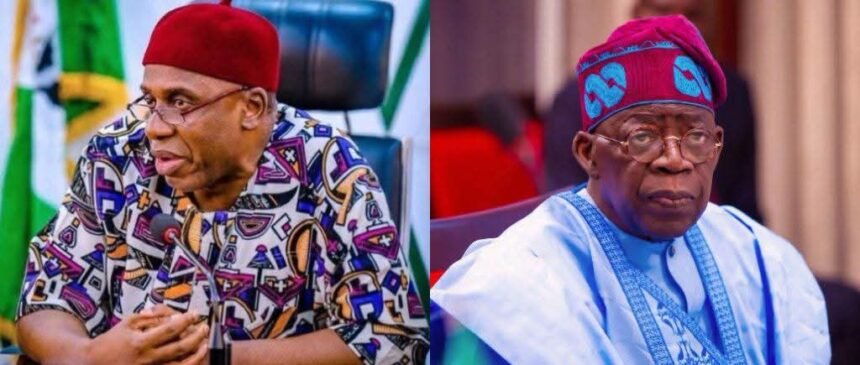
Former Minister of Transportation Rotimi Amaechi has claimed that he supervised the Lekki Deep Seaport project from inception to completion, accusing President Bola Tinubu and Lagos State Governor Babajide Sanwo-Olu of taking credit for the facility despite allegedly not being involved in its development from the beginning.
Amaechi made the remarks on Thursday at an African Democratic Congress (ADC) stakeholders’ meeting in Edo State, where he also questioned the economic justification for constructing additional seaports in Nigeria.
“I built Lekki Deep Seaport from scratch to finish. I finished it completely, but I had resigned to contest for the office of the president, that’s why Sanwo-Olu got Buhari to come and commission it,” he said.
The former minister alleged that Tinubu and Sanwo-Olu presented themselves as having built the port during its commissioning, despite what he described as their lack of involvement in the project’s early stages.
“And when they were commissioning, Sanwo-Olu and others, including Tinubu, were claiming that they built it. None of them visited it from scratch,” Amaechi added.
He, however, acknowledged the roles of former President Muhammadu Buhari and his predecessor, Olusegun Obasanjo, in the project’s history.
According to Amaechi, the idea of developing the port predated Buhari’s administration, although the former president approved its construction.
“Buhari approved the construction of that seaport, but it was essentially an Obasanjo’s idea, even though it was built by Buhari,” he said.
Lekki Port Project Spanned Multiple Administrations
The Lekki Deep Seaport, one of Nigeria’s major maritime infrastructure projects, was developed through a partnership involving the Federal Government, the Lagos State Government and private investors.
Plans for a deep seaport in the Lekki area had been under consideration before Amaechi became transportation minister. A concession agreement for the project was executed in December 2018 under the Buhari administration, during which Amaechi supervised the Federal Government’s transportation portfolio.
The port, estimated to have cost approximately $1.5 billion, was developed with the participation of China Harbour Engineering Company and the Tolaram Group, alongside financing partners, including the China Development Bank.
Under the reported ownership arrangement, private investors held the majority stake, while the Lagos State Government owned approximately 20 per cent and the Federal Government, through the Nigerian Ports Authority, held about five per cent.
The project therefore involved several institutions and stakeholders, including government authorities responsible for approvals, private investors providing capital and companies involved in its construction.
Amaechi’s comments place emphasis on his role in supervising the federal government’s involvement and overseeing the project during his tenure as minister. However, his claim to having built the port from start to finish has raised questions about how credit should be distributed among the various participants.
The facility was commissioned by Buhari in January 2023, after Amaechi had left office in 2022 to contest the All Progressives Congress presidential ticket. Tinubu, who attended the political transition period as the APC presidential candidate and a former Lagos governor, was not yet president at the time.
Neither the Presidency nor Sanwo-Olu’s office had issued a direct response to Amaechi’s latest allegations in the report of his remarks.
Amaechi Challenges Economic Case for More Seaports
Beyond the Lekki project, Amaechi questioned the need for additional major seaports, arguing that Nigeria’s current level of production might not justify expanding its port infrastructure.
He extended his criticism to the proposed Gateway Deep Seaport in Ogun State, which has been linked to an investment package reportedly exceeding $7 billion involving DP World and a proposed marine economic zone.
The former minister accused Tinubu of acting against the interests of Ogun State residents, suggesting that the proposed project was being driven by financial considerations rather than the needs of the people.
However, proponents of the Gateway Deep Seaport have argued that the project could help ease pressure on Lagos ports, particularly Apapa and Tin Can Island, while improving cargo movement, reducing logistics costs and supporting industrial development.
The disagreement reflects a broader debate about Nigeria’s maritime future: whether new ports would stimulate trade, attract investment and improve the movement of goods or create excess capacity without sufficient cargo demand.
Political Credit and Nigeria’s Infrastructure Debate
Amaechi’s intervention has brought renewed attention to the politics surrounding major infrastructure projects that take years to develop and often outlast the administrations that initiate, approve, finance or complete them.
The Lekki Deep Seaport’s development involved successive governments, private-sector investors and international financing partners, making it a project whose history cannot be separated from the contributions of multiple stakeholders.
While Amaechi insists that he oversaw the project through completion, his remarks have reopened the question of whether any single political officeholder can reasonably claim sole credit for an undertaking of this scale.
His criticism of the proposed Gateway Deep Seaport also highlights the competing policy positions over how much port capacity Nigeria needs and whether new maritime investments can drive economic growth while addressing existing logistics bottlenecks.