

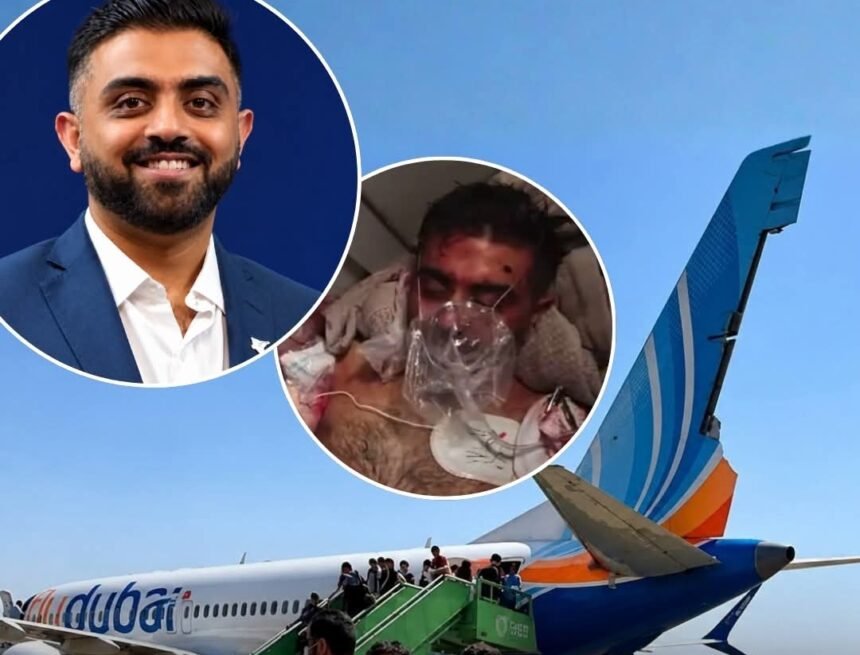
The captain of a flydubai flight involved in a violent cockpit confrontation while en route from Dubai to Tel Aviv has been identified by Indian media as Smit Machchhar, an Indian national and Boeing 737 captain with the airline.
Machchhar was reportedly injured after the first officer allegedly attacked him with a knife during the flight deck confrontation aboard Flydubai Flight FZ1073 on Wednesday. Flydubai has confirmed that an altercation occurred in the cockpit but has not publicly confirmed the identities or nationalities of the pilots.
The aircraft, a Boeing 737 MAX 8, was flying from Dubai International Airport to Ben Gurion Airport in Tel Aviv when the incident unfolded. According to Reuters, Israeli officials said the first officer, reportedly an Omani national, appeared to have stabbed the captain before other crew members and passengers intervened.
Passengers reportedly heard screams coming from the cockpit before the flight deck door opened. Videos and photographs circulating from the aircraft appeared to show injured pilots receiving oxygen, while blood could be seen in the area outside the cockpit.
Both pilots were subsequently taken to hospital after the aircraft made an emergency landing in Tabuk, Saudi Arabia. Saudi authorities confirmed that both sustained injuries. A passenger cited by Reuters said one pilot appeared seriously injured and the other slightly injured, although there was no independent confirmation of their conditions.
Machchhar reportedly joined flydubai as a captain in 2022 after previously flying for SpiceJet. Indian media reports say he has accumulated thousands of hours of flying experience. However, details about his current medical condition have not been officially released.
Aircraft plunges nearly 14,000 feet
The confrontation was accompanied by a dramatic loss of altitude.
Flight-tracking data cited by Reuters showed that the aircraft suddenly descended by nearly 14,000 feet in less than 30 seconds. It subsequently transmitted the international 7700 emergency code, before switching several minutes later to 7500, the transponder code indicating unlawful interference.
The precise sequence of events and the relationship between the cockpit confrontation and the aircraft’s descent remain under investigation.
As the crisis unfolded, passengers and crew reportedly forced their way into the cockpit and helped restrain the alleged attacker. Other pilots travelling as passengers also reportedly assisted in stabilising the aircraft and preparing it for an emergency landing.
The aircraft was eventually diverted to Tabuk, where it landed safely. Flydubai said all passengers and crew were safe and accounted for and that on-duty crew members travelling on the flight helped secure the aircraft. The airline subsequently sent two replacement aircraft to Tabuk to assist the affected passengers and crew.
Israel scrambled fighter jets
The transmission of the 7500 code triggered a major security response in Israel, with fighter jets reportedly scrambled amid initial fears that the aircraft had been hijacked.
Israeli officials later said the incident was not believed to be a conventional hijacking. Prime Minister Benjamin Netanyahu said the co-pilot had allegedly attempted to crash the aircraft, while Israeli officials described the incident as a possible deliberate attack. Reuters reported that Israeli officials were considering a terrorism-related motive.
However, the motive and precise circumstances remain unclear. Flydubai has urged against premature speculation, saying the reasons behind the incident remain subject to a formal investigation.
The aircraft also appeared to have sustained damage to its tail during the emergency. Images taken after landing appeared to show a substantial section of the rudder missing, although the cause and extent of the damage have yet to be officially established.
The investigation by Saudi, Israeli and aviation authorities is continuing.