

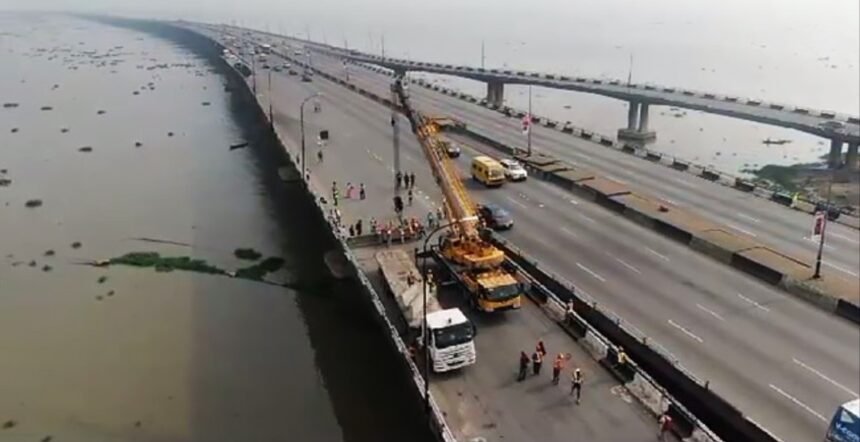
Deutsche Bank has expressed interest in financing major rehabilitation and replacement works on two of Lagos’ most critical transport corridors—the Carter Bridge and the Third Mainland Bridge—as the Federal Government intensifies its push to attract private capital for large-scale road infrastructure.
A delegation from the bank, led by its Managing Director and Global Co-Head of Structured Trade and Export Finance, Moritz Dornemann, and Chief Country Representative in Nigeria, Andreas Voss, met with Minister of Works David Umahi in Abuja on Tuesday. The visit also reaffirmed the bank’s interest in further financing sections of the Lagos-Calabar Coastal Highway.
According to a statement by Umahi’s Special Adviser on Media, Orji Uchenna, the engagement forms part of the Federal Government’s efforts to build sustainable partnerships with global financiers to accelerate funding for strategic infrastructure projects.
The Deutsche Bank team said it was impressed by the Federal Government’s determination to upgrade ageing transport infrastructure and lauded President Bola Tinubu’s commitment to delivering transformative road projects aimed at boosting national productivity. They specifically indicated interest in financing the replacement of the Carter Bridge and the comprehensive rehabilitation of the underwater elements of the Third Mainland Bridge—Africa’s second-longest bridge.
The statement said, “In their mission statement, the team from Deutsche Bank noted that they came to indicate interest in the funding of the replacement of Carter Bridge, Lagos, and the rehabilitation of 3rd Mainland Bridge, Lagos. They commended the President for his commitment to large-scale and quality road infrastructure, which is critical for sustainable economic growth.”
The bank also praised the quality of work being carried out by Hitech Construction Ltd on the Lagos-Calabar Coastal Highway, saying the progress had strengthened investor confidence in Nigeria’s capacity to deliver complex infrastructure and expanded the bank’s appetite to support future phases of the project.
Responding, Umahi commended the lender for its growing confidence in Nigeria’s infrastructure programme. He revealed that the Lagos-Calabar Coastal Highway had already been “oversubscribed by over $100 million” by investors. He added that Deutsche Bank had shown interest in reassessing the project’s cost, which they believe may be undervalued.
The minister disclosed that the Carter Bridge had deteriorated to the point where replacement is now the only viable option, although remedial interventions are ongoing. He also noted that the Third Mainland Bridge, which has undergone multiple repair phases in the last decade, now requires full underwater structural rehabilitation to extend its lifespan by another 50 years.
He assured the bank’s delegation that both bridge projects were moving through an impartial procurement process and pledged that Deutsche Bank would be carried along once successful bidders emerge.
The engagement marks a significant step in the Federal Government’s renewed efforts to court reputable global financiers amid widening funding gaps in national road infrastructure—especially in Lagos, where decades of saltwater corrosion, heavy traffic, and ageing structures have placed critical bridges under pressure.
Built in 1990, the 11.8km Third Mainland Bridge remains one of Nigeria’s most vital transport routes but has shown repeated signs of structural strain, prompting several rounds of rehabilitation since 2012.
Similarly, the Carter Bridge—first built in 1901 and rebuilt in the 1970s—has battled corrosion, structural fatigue, and overstressed components, leading the government to prioritise a full replacement to avert long-term risks.