

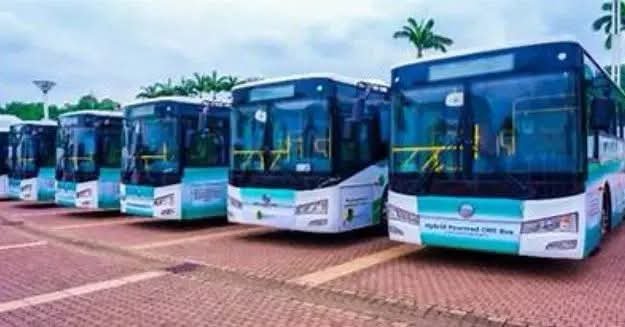
The Federal Government has announced plans to subsidise the conversion of vehicles owned by university lecturers and other workers to Compressed Natural Gas as part of measures to reduce transportation costs.
The government will also deploy 100 CNG-powered buses to 20 public universities under the pilot phase of its Campus Transport Scheme, with fares capped at N150 per trip.
A member of the Presidential Initiative on CNG Electric Vehicles, Tosin Coker, disclosed this on Thursday in Lagos at a briefing on the CNG Campus Transportation Fare Reduction, also known as Project SPROUT.
The briefing was held at the main gate of the University of Lagos, Akoka.
Coker said the initiative was designed to reduce transport expenses for students, lecturers and other university workers.
He said the scheme was part of the Federal Government’s commitment to a promise made during its engagement with the Academic Staff Union of Universities.
“About two years ago, when the Federal Government, through the Office of the Chief of Staff to the President, brokered a peace deal with the leaders of ASUU, one of the promises made was to reduce transport cost and we are continuing in the fulfilment of the promise,” he said.
Coker added that an average household spends more than 20 per cent of its income on transportation, stressing that the government was determined to bring down the cost.
He said 100 CNG buses would initially be deployed to selected universities, with the programme eventually extended to other campuses.
He also disclosed that lecturers, university workers and members of the public would be able to convert their vehicles to CNG at designated conversion centres, with part of the cost subsidised by the Federal Government.
The Chief Executive Officer of FEMADEC Group, Fola Akinnola, which is partnering with the presidential team on the project, said Project SPROUT was designed to provide sustainable relief from rising transportation costs.
According to him, the scheme uses locally available gas resources as an alternative to imported fuel, with a model intended to maintain affordable fares without continuous government funding.
Akinnola said the model was already operating at the Federal University of Technology, Owerri; the University of Abuja; and Obafemi Awolowo University, Ile-Ife.
He described UNILAG as proof that the model could be replicated across other campuses, adding that students under the scheme would pay N150 per trip.
The Deputy Vice-Chancellor of UNILAG, Prof. Muyiwa Falaiye, who represented the Vice-Chancellor, Prof. Folasade Ogunsola, commended the initiative.
Falaiye said the conversion of vehicles to CNG would help reduce transportation costs and called for the sustainability of the programme across Nigerian universities.