

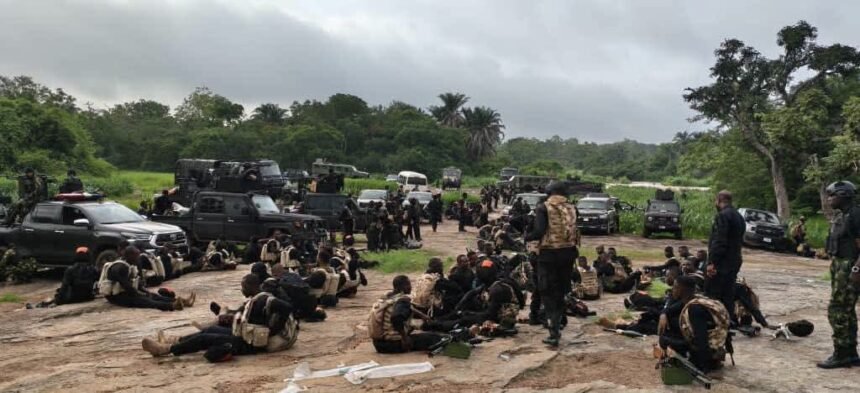
The rescue of the abducted pupils and teachers from Oriire, Oyo State, was not the result of a rushed military assault. It was the culmination of a carefully coordinated, intelligence-driven operation that combined patience, surveillance, psychological pressure and seamless inter-agency cooperation.
Here is a blow-by-blow account of how the operation unfolded:
1. The Abduction
On May 15, 2026, Ansaru terrorists abducted pupils and teachers from Oriire in Oyo State and disappeared into the vast Oyo National Forest.
Immediately after the incident, President Bola Tinubu directed security agencies to ensure the safe return of every hostage.
2. A Joint Task Force Was Established
Rather than leaving the operation to a single agency, the Chief of Defence Staff, in collaboration with the Service Chiefs and heads of other security agencies, constituted a Defence Headquarters-led Joint Inter-Agency Task Force.
The operation brought together elite personnel from the Nigerian Army, Navy Special Boat Service, Nigerian Air Force, Office of the National Security Adviser, Police, DSS, NIA, NSCDC and DIA under a unified command coordinated by the GoC 2 Division of the Nigerian Army, Ibadan, Major General Chinedu Nnebeife.
3. Hostage Safety Became the Priority
Security planners rejected the option of a hasty assault that could endanger the lives of the children and teachers.
Instead, they adopted a deliberate, intelligence-led strategy designed to wear down the terrorists while keeping the hostages alive.
4. Troops Gradually Closed In
For more than three weeks, troops advanced through the difficult terrain of the Oyo National Forest, carefully mapping terrorist camps, movement routes and hideouts.
Rather than rushing into combat, they steadily tightened the operational cordon, limiting the terrorists’ freedom of movement.
5. Intelligence and Air Surveillance Took Over
Continuous Intelligence, Surveillance and Reconnaissance (ISR) assets monitored the terrorists’ activities.
With support from the Nigerian Air Force, Navy and Police, security forces identified communication hubs, logistics bases and key operational positions inside the forest.
These facilities were systematically destroyed, weakening the terrorists’ ability to coordinate operations and sustain themselves.
6. The Terrorists’ Support Network Was Dismantled
While troops mounted pressure inside the forest, intelligence agencies simultaneously targeted the kidnappers’ external support structure.
Associates, informants and collaborators operating around the forest were arrested.
At the same time, relatives of suspected Ansaru members in several states—including Sokoto, Katsina, Kano, Zamfara and Oyo—were taken into protective custody as investigations widened.
7. Psychological Pressure Changed the Game
As pressure mounted, the kidnappers realised their support network had collapsed.
They were informed that harming the abducted children and teachers would have grave consequences for their organisation and their detained relatives.
Some of those relatives reportedly appealed directly to the terrorists to release the hostages.
The psychological advantage shifted decisively to the security forces.
8. The Terrorist Camp Began to Collapse
With logistics cut off, communication disrupted, key members eliminated and increasing defections within their ranks, the kidnappers became isolated.
Many fighters reportedly abandoned their leader as military pressure intensified.
The once-confident kidnappers found themselves surrounded, weakened and running out of options.
9. The Unconditional Release
Faced with total operational collapse, the terrorists capitulated.
On July 10, 2026, they released all the abducted pupils and teachers without conditions.
The victims were immediately taken for medical evaluation and psychosocial care before being reunited with their families.
A Victory Beyond Firepower
The rescue demonstrated that modern counter-terrorism is often won long before the final moment. Through patience, superior intelligence, coordinated operations and psychological strategy, Nigeria’s security agencies secured the safe return of every hostage without the devastating casualties that often accompany rescue missions.
It stands as one of the country’s most significant intelligence-led hostage rescue operations, highlighting the effectiveness of inter-agency collaboration under the coordination of the Office of the National Security Adviser and the Defence Headquarters.