

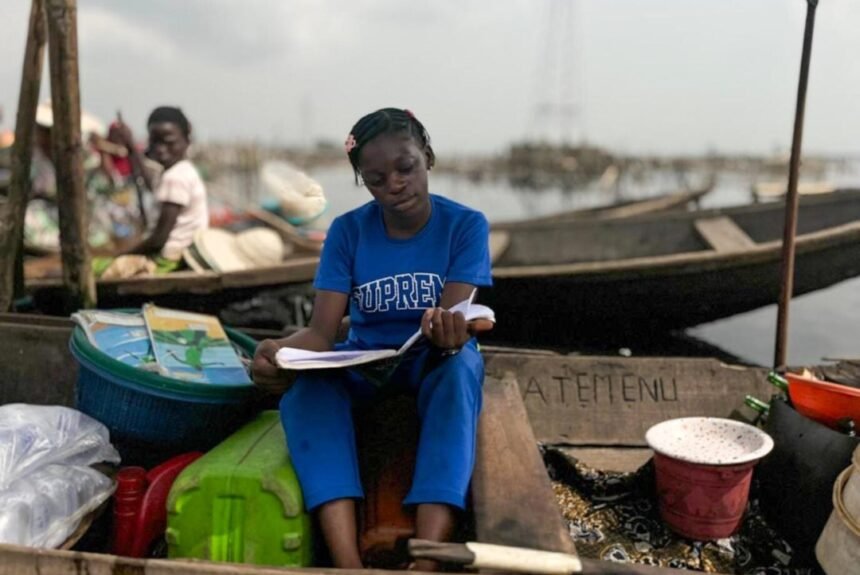
As canoes glide through thick, dark, murky water, they bump into one another, paddles scraping against unseen debris beneath the surface. Voices of children and adults rise and fade into the heavy lagoon air as boats squeeze through Makoko’s narrow waterways, where survival leaves little room for caution. Boys stand upright in canoes, steadying themselves with bamboo paddles nearly three times their height. When paddles fail, they step into the water, pushing and pulling to keep passengers and goods from spilling into the lagoon.
This is daily life in Makoko, a waterfront community in the Ayetoro area of — Nigeria’s commercial hub of nearly 18 million people.
As the city’s population grows and housing costs soar, thousands have been pushed to the margins, building homes on water in response to the pressures of megacity life. Often called the “Venice of Africa,” Makoko is home to an estimated 300,000 people and is believed to date back to the 19th century.
Beneath its wooden walkways and stilted houses, the lagoon carries decades of neglect — plastic waste, human refuse, and stagnant water. Yet above it, life goes on. Women sell garri, petrol, sachet water, tomatoes, and peppers from canoes and narrow wooden platforms that transform by the hour — shops in the morning, kitchens by afternoon, sleeping spaces by night. Smoke curls from makeshift stoves, blending with the smell of damp wood as meals are cooked in swaying boats.
That fragile rhythm was shattered in December 2025, when state authorities began demolitions across parts of the settlement.
Aioli Tyerry, a fisherman and tailor, had paddled out before dawn on Christmas Eve. Unlike most days, he planned to keep his catch to celebrate with his family. When he returned, his two-storey wooden home was gone.
“I went fishing, and I came back homeless,” he said.
His sewing machine — his second source of income — was destroyed, along with his clothes, savings, and customers’ garments. By nightfall, even his next meal was uncertain. Though officials said the demolitions targeted buildings within safety setbacks around high-tension power lines, Tyerry insists his home lay outside the agreed 100-metre boundary.
Residents say they were first told a 30-metre buffer would be enforced, later expanded to 50 metres and then 100 metres. But demolition teams allegedly went far beyond that limit without fresh notice, sparking protests that were dispersed with tear gas.
State authorities maintain that residents had been engaged over the years, issued notices, and compensated, insisting the exercise was necessary to prevent disasters around power lines and waterways.
Now, Tyerry, his wife, and their three children sleep in a makeshift shelter by the lagoon’s edge. His children are no longer in school. If asked where he would go next, he answers simply: the streets.
Civil society groups have condemned the exercise, alleging that it reflects a pattern of clearing valuable waterfront land for elite interests without adequate consultation, compensation, or resettlement. They claim thousands have been displaced and at least a dozen deaths recorded across Makoko and other communities affected by recent demolitions.
Education on Hold
The impact has rippled through every aspect of life, including education. Classrooms lie in ruins, uniforms submerged in water, lessons suspended.
Sixteen-year-old Yemi Peter, an SS1 student, now spends her days paddling a canoe, selling petrol and food items to passing boats. Since the demolition, she has stopped attending school.
“I like living in Makoko,” she said quietly. “This is where I know.”
With nowhere else to go, she sleeps alone on a boat in the middle of the lagoon.
In January, residents and supporters marched to the state assembly complex, demanding an end to the demolitions and seeking an audience with Governor . The protest was dispersed, and activists were arrested and charged. Police denied that anyone was injured and rejected claims that the exercise was anti-poor.
Under growing pressure, the later called for an immediate suspension of demolition activities in Makoko and neighbouring communities.
Environmental activist , director of the , described the Makoko demolitions as part of a long history of forced evictions that exclude poor communities from Lagos’ megacity vision.
“There are regulations on setbacks around high-tension cables, and the people agreed to those,” he said. “But what happened went far beyond 100 metres. That is no longer about prevention.”
He dismissed sanitation arguments used to justify the exercise, warning that the destruction of homes, schools, and clinics has disrupted livelihoods and deepened exclusion.
As Lagos pushes ahead with its megacity ambitions, authorities argue that redevelopment and waterfront regeneration are necessary to modernise the city and attract investment. For many Makoko residents, however, that vision has meant displacement, loss, and an uncertain future — lives untethered from the lagoon they have long called home.