

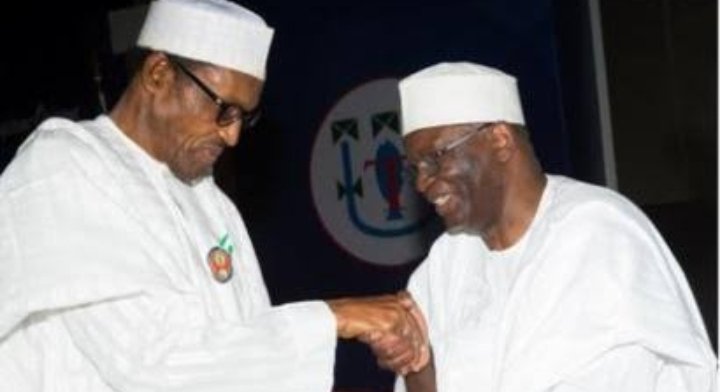
Prof Ibrahim Gambari, former Chief of Staff to the late President Muhammadu Buhari, has confirmed the existence of a “cabal” during Buhari’s presidency, stating that such inner circles are common to all governments.
Speaking in a yet-to-be-aired interview with Laolu Akande, former spokesperson to ex-Vice President Yemi Osinbajo, Gambari clarified that while the term “cabal” may carry negative connotations, it essentially refers to a close-knit group of trusted advisers — something he believes is intrinsic to the nature of executive leadership.
“I would address it honestly and on the record,” Gambari said. “They say there’s a cabal — or was a cabal. There was, but every government has a cabal. It depends on what you call them. Some say ‘kitchen cabinet’, others say ‘think tank’.”
Citing past administrations, Gambari referenced former President Olusegun Obasanjo’s inner circle, including noted intellectuals like Prof Ojetunji Aboyade, to underscore that the reliance on select individuals for counsel and influence is a long-standing norm.
“It is the nature of the office of the president that they must have people — in or out of government — they can speak with freely, let their hair down,” he added. “Some have more influence than others, but I make bold to say every government has a cabal by one name or another.”
The issue of cabals in Nigerian presidencies has long been controversial. Critics often argue that these unelected figures wield disproportionate power over national policy and appointments, operating in secrecy and undermining democratic processes.
In 2018, First Lady Aisha Buhari publicly criticized the alleged dominance of a few individuals in her husband’s administration, warning that they were hijacking power from the people. Her comments stirred national debate, though President Buhari downplayed her concerns at the time.
Gambari’s remarks add a layer of confirmation to long-standing speculations, reinforcing the notion that informal power structures — whether called cabals, inner circles, or kitchen cabinets — are an enduring feature of Nigerian leadership.