

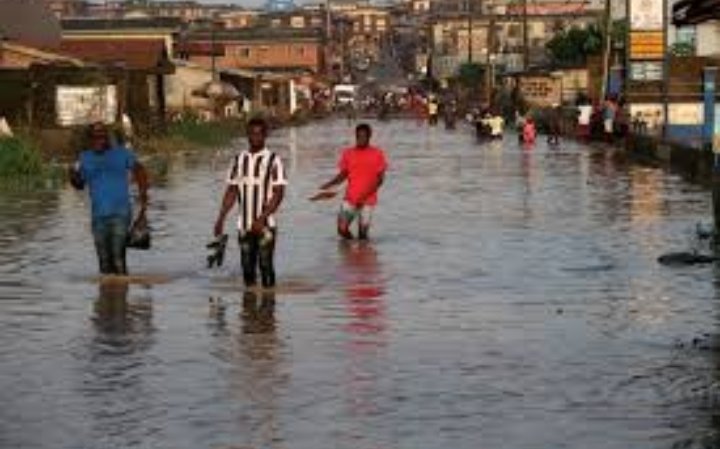
Some parts of Lagos—one of the high-risk states for flooding—experienced flash floods earlier this week, prompting swift intervention from the state government.
The Lagos State Government attributed the flooding to rising tidal levels from the Atlantic Ocean and the Lagos Lagoon. Commissioner for the Environment and Water Resources, Tokunbo Wahab, disclosed this via his official X (formerly Twitter) handle on Wednesday, urging residents to remain calm as emergency teams monitor the situation.
“The Lagos State Government wishes to inform the public that the flash flooding currently being experienced in parts of the city is due to increased tidal levels from both the Atlantic Ocean and the Lagos Lagoon,” Wahab stated.
He also warned residents against dumping waste into gutters and drainage channels, noting that such actions block water flow and worsen flooding.
On Monday, operatives of the Emergency Flood Abatement Gang intensified efforts to clear blocked drains in key areas of the state, including Ajegunle (Ifelodun LCDA), Meiran (Agbado-Oke Odo LCDA), Lewis Street by Beecroft Street (Lagos Island), Ayinke Timson Drive (Amuwo Odofin LGA), and Samuel Manuwa Street (Ikoyi-Obalende, Eti-Osa).
Despite the government’s response, some residents are taking personal precautions. In Lekki, resident Olumide Samuel said he had relocated his family to another part of the state to avoid danger.
“Every year, Lagos comes under heavy flooding, and my area is always affected. Though the state government is making efforts, they need to do more. In the interim, I’ve moved my family to stay with my mum. It’s something we do every year, pending when the water dries off,” he said.
Meanwhile, residents in flood-prone areas across 20 states have begun relocating following a fresh warning by the Nigerian Meteorological Agency (NiMet).
In its July flood alert issued Monday, NiMet listed Lagos alongside Sokoto, Edo, Benue, Yobe, Bayelsa, Jigawa, Delta, Cross River, Kaduna, Ondo, Adamawa, and Nasarawa as states likely to experience flash floods due to expected heavy rainfall in the coming months.
NiMet advised residents in vulnerable zones to prepare emergency kits, clear drainage systems, switch off electricity and gas during flooding, and promote community awareness campaigns to reduce risk.