

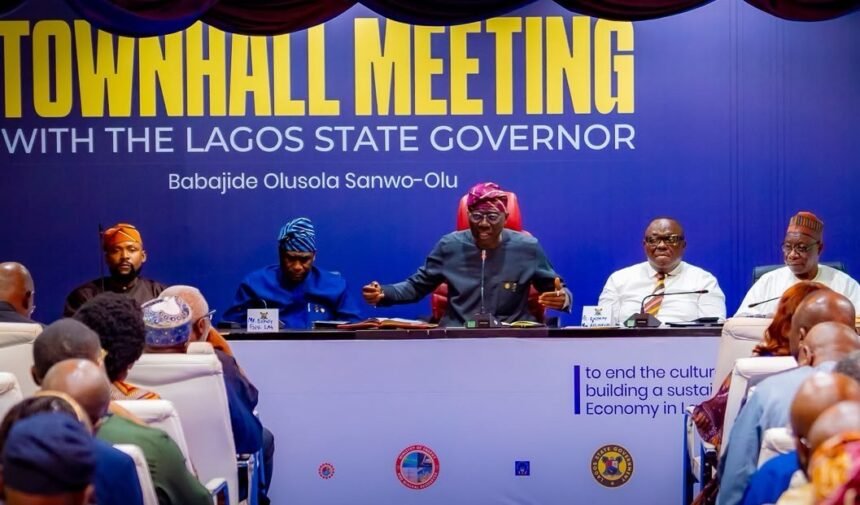
Lagos State Governor, Babajide Sanwo-Olu, has unveiled a fresh strategy to tackle persistent power outages in the state, with the government targeting an increase in available electricity supply to 3,500 megawatts (MW).
Sanwo-Olu announced the plan on Thursday at the Lagos State High-Level Strategic Power Town Hall held at Lagos House, Marina, where key stakeholders in the electricity sector met to assess the state’s power situation and develop practical solutions.
The governor said the state government would work with regulators, electricity distributors, transmission operators, investors and other stakeholders to improve generation, transmission, distribution and metering, with the ultimate goal of achieving reliable, 24-hour electricity supply.
He called for stronger coordination across the electricity value chain, alongside smart metering, improved data management, enforcement and revenue assurance to restore consumer confidence and attract investment into the sector.
The Minister of Power, Joseph Tegbe, represented by the Director of Distribution Services in the Federal Ministry of Power, Baba Mustapha, said Lagos requires more than 6,000MW but currently receives significantly less from the national grid.
He noted that increased generation alone would not solve the problem without adequate transmission and distribution infrastructure, identifying gas supply, transmission capacity, distribution bottlenecks and metering as critical areas requiring urgent attention.
The Special Adviser to the President on Power and Chairman of the Presidential Taskforce on Power Sector Reset and Restoration, Rilwan Lanre Babalola, said the challenge was no longer simply about generating more electricity but about creating a functional and sustainable electricity market.
Babalola said the proposed Clean Lagos Electricity Market (CLEM) could help transform Lagos’ huge electricity demand into an investable market through demand aggregation, bilateral contracts, open access, payment assurance and transparent settlement.
He also noted that constitutional amendments and the Electricity Act had created opportunities for states to establish and regulate their electricity markets.
The Lagos State Commissioner for Energy and Mineral Resources, Abiodun Ogunleye, said the meeting was aimed at ending what he described as the “culture of blackout” in Lagos.
Ogunleye said the state would develop clear action points and establish a baseline against which progress would be measured at a proposed six-month review.
On electricity tariffs, the commissioner said improved supply must go hand in hand with payment, stressing that consumers should not be made to pay for electricity they do not receive.
He added that the target would enable more feeders to operate and increase electricity supply to homes, businesses and industries.
The Chief Executive Officer of the Lagos State Electricity Regulatory Commission, Temitope George, identified inadequate generation and transmission, energy theft, vandalism and non-payment of electricity bills as major challenges affecting the sector.
George urged consumers to pay for electricity consumed, warning that non-payment distorts the electricity market and undermines reliable supply.
She also disclosed that Lagos was exploring embedded power generation as a way of complementing national grid supply and reducing dependence on the grid.
The town hall ended with a commitment by stakeholders to convert the discussions into concrete action points, establish measurable benchmarks and periodically review progress towards improving electricity supply across Lagos.