

By Juli Ihejirika
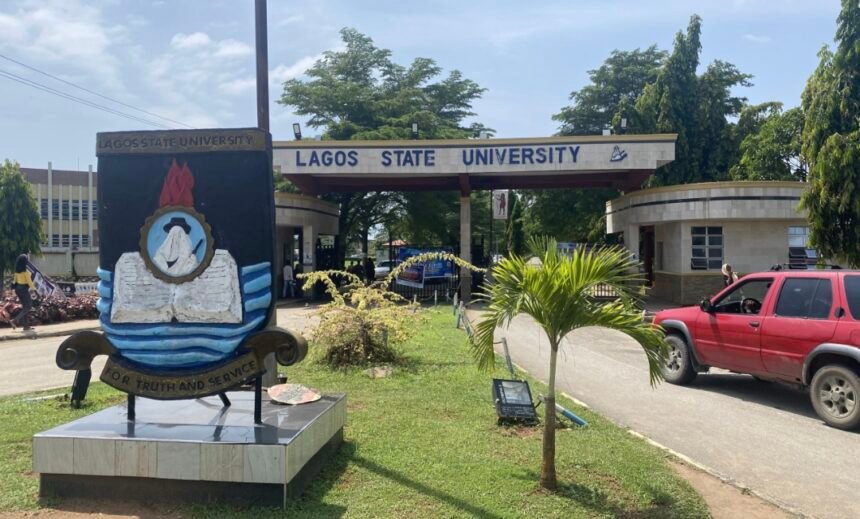
The recent directive by the Lagos State University (LASU) that all courses with more than 400 students must henceforth be conducted online has sparked outrage among students, parents, and education analysts.
The policy, which the university management touts as an “innovative” measure to curb overcrowding, is now being widely criticized as a poorly conceived and exploitative shortcut that exposes deep cracks in the institution’s planning and infrastructure.
In a memo circulated by the Lagos State University Students’ Union (LASUSU) Public Relations Officer, Comrade Akano Abdul Malik Kolade, the management announced that classes would now be conducted through platforms such as LASU Radio (95.7 FM), DigiLearn, Zoom, and the university’s Learning Management System (LMS). Lecturers were instructed to adapt their courses to these platforms for “seamless virtual learning.”
But critics say LASU’s digital transition is nothing more than a desperate response to administrative failure. “This is not innovation; it is improvisation,” said one education analyst. “LASU has been admitting far more students than its facilities can handle, and rather than expand infrastructure, it is hiding under the cover of technology.”
Indeed, the numbers tell the story. In the 2023/2024 academic session, LASU admitted over 12,800 students out of more than 50,000 applicants. This year, JAMB data shows the university remains Nigeria’s most sought-after, attracting more than 70,000 candidates.
But popularity should not be mistaken for capacity.
*Parents Cry Foul*
Parents have also expressed anger over the sudden shift to online learning, describing it as unfair and exploitative. “We paid for accommodation, transportation, and medical fees on the understanding that our children were enrolled for on-campus learning,” said one aggrieved parent. “How can they now tell us to keep them at home and learn on Zoom? That’s not innovation — it’s deception.”
Education observers warn that the decision may amount to a breach of trust, as the university changed learning conditions after collecting full payments. “You don’t alter the contract midway without consultation,” said another commentator. “It’s unethical and insensitive.”
*The Real Issue: Poor Planning and Over-Admission*
The real problem, analysts argue, is LASU’s chronic infrastructural deficit and over-admission culture. According to the National Universities Commission (NUC), the acceptable student-to-classroom ratio for large state universities is 100:1. LASU reportedly exceeds that figure several times over.
Instead of building new lecture halls or expanding capacity, the university has opted to shift the burden to students — a move critics describe as “lazy administration dressed as digital innovation.”
*Digital Learning or Digital Exclusion?*
Beyond the moral questions lie hard realities. Nigeria remains grossly unprepared for large-scale online education.
According to the National Bureau of Statistics (NBS, 2023), only 38% of households have stable internet access, and power supply in most urban centres, including Lagos, averages less than 12 hours daily.
For thousands of LASU students — many from working-class families — online learning will mean attending classes on low-end phones, battling network instability, and struggling with erratic electricity. “This policy will exclude rather than empower,” said a university lecturer who requested anonymity. “It’s digital exclusion disguised as modernization.”
*LASUSU’s Silence: Complicity or Cowardice?*
Students have also expressed disappointment with their union’s handling of the issue. LASUSU’s official statement echoed the management’s tone, urging compliance rather than challenging the decision.
“The union’s job is not to echo the authorities but to defend students’ interests,” said a final-year student from the Faculty of Social Sciences. “At a time when our rights are being trampled, LASUSU’s silence is complicity.”
*Revenue Drive and the Stream B Controversy*
Observers say LASU’s resort to virtual learning is linked to its aggressive Internally Generated Revenue (IGR) agenda. Years ago, the university introduced “Stream A” and “Stream B” programmes, with the latter attracting higher tuition fees under the promise of enhanced entrepreneurial courses and superior facilities.
But over time, the distinction between both streams has blurred. Students now attend the same lectures, taught by the same lecturers, with no tangible difference except in the fees paid. Critics call it “revenue-driven deception,” adding that the online directive may be another ploy to manage overcrowding caused by excessive admissions under the two-stream model.
Education experts warn that forced online learning, without adequate preparation or infrastructure, will compromise academic quality. UNESCO’s 2021 post-COVID study showed that 65% of Nigerian tertiary students experienced a decline in comprehension during full online learning.
Courses requiring laboratory work, field engagement, or oral presentation cannot be effectively taught virtually. Large online classes also limit lecturer-student interaction, erode assessment integrity, and heighten the risk of plagiarism and absenteeism.
“The outcome will be graduates who are digitally exhausted but intellectually undernourished,” one academic warned. “That’s not education — it’s academic erosion.”
Critics say LASU’s management failed the test of accountability. Before making such a far-reaching change, it should have consulted key stakeholders — students, parents, faculty, and regulators — and provided practical alternatives like data subsidies, device loans, or structured hybrid options.
“To impose a new learning system after collecting full payment is a breach of moral and institutional trust,” said a policy analyst. “It suggests a university more concerned with convenience than compassion.”
*What LASU Should Do*
Stakeholders have outlined a number of urgent steps the university must take to restore confidence and credibility:
– Align admissions with capacity by reviewing the student intake policy.
– Expand infrastructure through investment in lecture halls and ICT hubs.
– Adopt a true hybrid learning system, not a hasty shift born of panic.
– Ensure transparency in the Stream A/B structure and tuition differences.
– Rebuild trust through open communication with students and parents.
*Government Oversight Urgently Needed*
Education stakeholders are calling for immediate intervention by the Lagos State Ministry of Education, the Lagos State House of Assembly Committee on Education, and the National Universities Commission (NUC).
“This policy raises fundamental questions about educational quality, institutional accountability, and the balance between revenue generation and public responsibility,” said one education advocate.
*Final Word: Stop the Digital Deception*
True innovation is driven by foresight, not fear. LASU cannot continue to admit beyond its capacity and then dump the burden on students under the guise of technology. Digital learning should bridge inequality, not deepen it.
If unchecked, this policy could erode LASU’s reputation as one of Nigeria’s foremost state universities and reduce it to a cautionary tale in administrative failure.
Education is not a business transaction; it is a public trust. LASU must remember that no university modernizes by abandoning its students. And no amount of Wi-Fi can compensate for broken trust.