

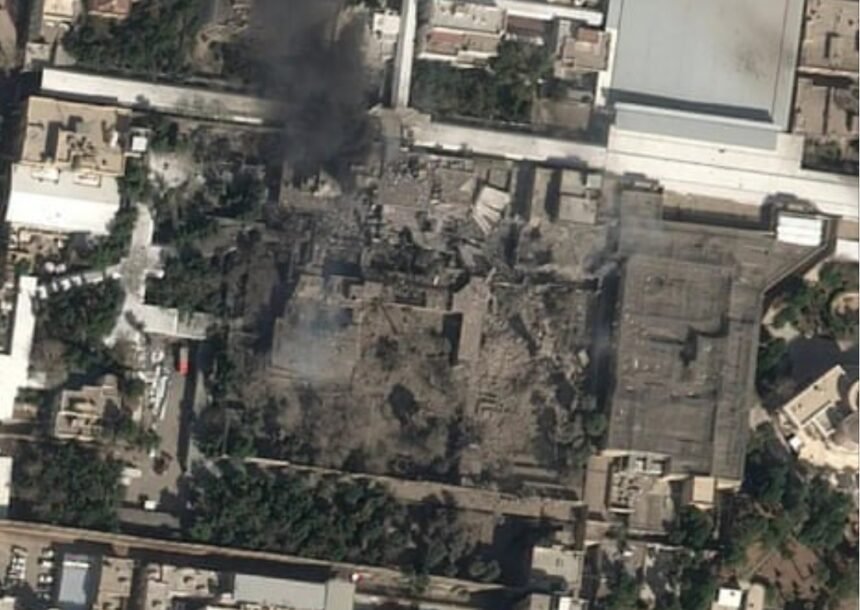
Israeli officials say Iran’s Supreme Leader, Ali Khamenei, has been killed following a large-scale military operation carried out by Israel and the United States. There has been no immediate confirmation from either Washington or Tehran.
According to Israeli sources who spoke to The Associated Press on condition of anonymity, Khamenei died after strikes targeted his compound in Tehran early Saturday. In a televised address, Israeli Prime Minister Benjamin Netanyahu said there were “growing signs” that the Iranian leader had been killed.
Iranian officials have not confirmed the claim. Earlier, Foreign Minister Abbas Araghchi told NBC News that Khamenei and President Masoud Pezeshkian were alive “as far as I know,” describing the strikes as “unprovoked, illegal and absolutely illegitimate.”
If confirmed, Khamenei’s death would mark a historic turning point for the Islamic Republic. He succeeded Ruhollah Khomeini after the 1979 Islamic Revolution and has since held ultimate authority over Iran’s political, military, and religious institutions, including the powerful Revolutionary Guard.
The strikes represent a major escalation in regional tensions. In a video address, U.S. President Donald Trump urged Iranians to “seize control of your destiny” and take over their government once military operations conclude. He said the U.S. targeted Revolutionary Guard command facilities, air defenses, missile and drone launch sites, and military airfields.
Iranian state media reported that at least 201 people were killed and more than 700 injured in the attacks. Tehran retaliated with missile and drone strikes aimed at Israel and U.S. military installations in the region, including sites in Bahrain, Kuwait and Qatar. Israel said it intercepted many of the incoming missiles, while emergency services reported dozens of minor injuries.
Israel also claimed that other senior Iranian officials were killed, including the commander of the Islamic Revolutionary Guard Corps and Iran’s defense minister. These claims have not been independently verified.
The United Nations Security Council is set to meet in response to the escalation. The U.N.’s nuclear watchdog said it had seen no evidence of radiological impact at targeted nuclear facilities but was closely monitoring developments.
The attack follows months of rising tensions tied to Iran’s nuclear program and stalled negotiations. It is the second time in less than a year that U.S. forces have struck Iranian targets amid diplomatic efforts to revive nuclear talks.
Analysts warn that even if Iran’s top leadership has been severely weakened, regime change is not guaranteed. The situation raises the risk of prolonged regional instability, potential disruptions to global oil markets — particularly through the Strait of Hormuz — and further military exchanges across the Middle East.
As of now, the reported death of Iran’s Supreme Leader remains unconfirmed by Iranian authorities.