
Lagos State Governor Babajide Sanwo-Olu has described promises by opposition politicians to restore fuel subsidy as “empty campaign buzz,” arguing that the policy is no longer fiscally sustainable.
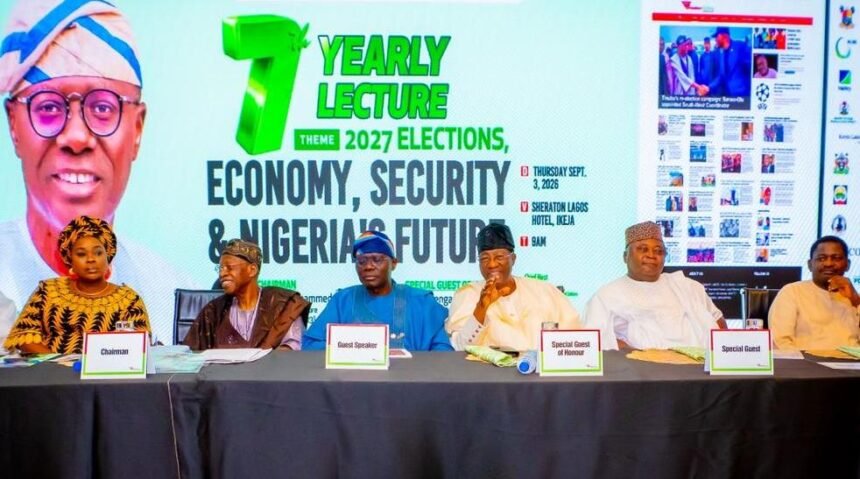
Sanwo-Olu spoke on Thursday while delivering the 7th Freedom Online Newspaper Lecture, themed “2027 Elections, Economy, Security and Nigeria’s Future,” at the Sheraton Lagos Hotel, Ikeja.
The lecture, chaired by former Minister of Information and Culture, Lai Mohammed, focused on Nigeria’s economic reforms, security challenges and electoral development ahead of the 2027 general elections.
The governor defended President Bola Tinubu’s decision to remove petrol subsidy, saying the policy had become a major drain on government finances without delivering its intended benefits to ordinary Nigerians.
He said the subsidy removal had been painful, particularly for Lagos residents, but argued that the reform was necessary to redirect public funds towards infrastructure and other critical sectors.
“I will not stand here and tell you that oil subsidy removal has been painless. It has not. Lagosians particularly have felt it at the pump, at the market, and in the price of a bag of rice,” Sanwo-Olu said.
He added that the test of an economic reform was not whether it caused short-term hardship but whether it produced long-term benefits.
According to him, opposition politicians had already begun using the subsidy issue as a campaign tool barely two weeks into the 2027 presidential campaign season.
“We will see more of this. We will see promises that no treasury on earth could honour,” he said.
Sanwo-Olu also highlighted what he described as gains from the Tinubu administration’s economic reforms, including increased allocations to states and local governments, stronger external reserves, improved economic growth and rising remittance inflows.
He said Nigeria’s economy grew by 4.43 per cent in 2026, compared with 3.89 per cent in the first quarter, while agriculture and services recorded growth of 4.39 per cent and 4.6 per cent respectively.
The governor also praised Nigeria’s democratic development, saying the country’s electoral system had evolved significantly since 1999.
He cited the Electoral Act 2022, the Electoral Act 2026 and the increased use of technology in voter verification and results transmission as evidence of progress, while urging the Independent National Electoral Commission to ensure effective preparations for the 2027 elections.
On security, Sanwo-Olu said the Tinubu administration had strengthened the country’s security architecture through increased military personnel, new commands and greater investment in policing and other security agencies.
He also linked insecurity to poverty and unemployment, highlighting programmes such as NELFUND, the 3-Million Technical Talent programme, the Consumer Credit Corporation, the Nigerian Youth Academy and other youth-focused interventions.
Lai Mohammed, who chaired the event, said political stability depended largely on economic inclusion and security, stressing that the 2027 election should be viewed as an opportunity for continuity and nation-building rather than merely a contest for political power.
He urged political actors to ensure that politics did not undermine governance, while calling for patience, institutional strengthening and national cooperation in addressing the country’s economic and security challenges.
The Convener and Editor-in-Chief of Freedom Online, Gabriel Akinadewo, said the lecture was timely given the renewed political activities ahead of 2027. He called for the modernisation of Nigeria’s laws to reflect contemporary realities and the protection of citizens’ freedoms.