

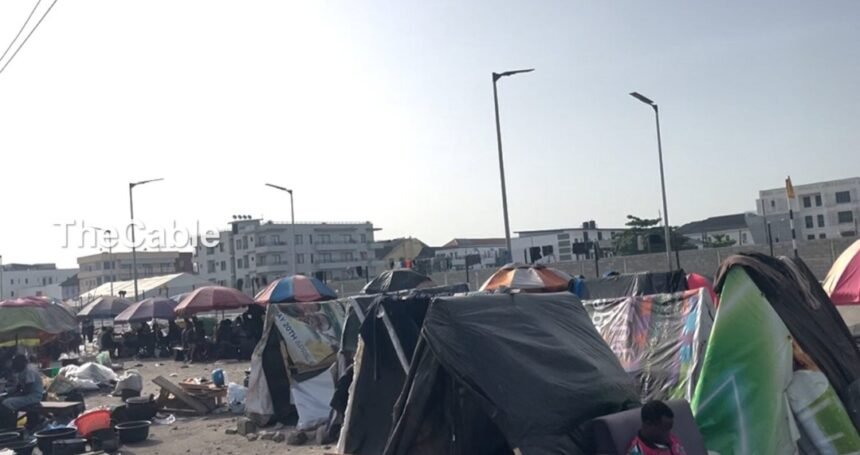
A growing stretch of informal settlements has emerged along sections of the Lagos-Calabar Coastal Highway, raising concerns about environmental degradation, insecurity, and the sustainability of the ambitious infrastructure project.
Behind the highway’s partitions along the Maruwa axis of the Lekki–Epe corridor, clusters of makeshift shelters built from wood, tarpaulins, and scrap materials now line the route. What appears at a glance as scattered structures is, on closer inspection, a dense and expanding community.
Many of the occupants say they are driven there by the high cost of housing in Lagos. Musa, a 29-year-old migrant from Kebbi State, said he had little choice but to settle in the area, noting that a basic shanty can be erected for between N20,000 and N30,000.
Within the settlement, a range of informal economic activities thrives — from barbing and phone charging services to petty trading. However, there are also reports of illicit drug sales, with substances such as marijuana, cocaine, and methamphetamine allegedly being traded openly.
Residents also described an informal leadership structure headed by a figure known as the “Sariki,” who is said to mediate between occupants and enforcement authorities. Some claim that periodic levies are collected from business operators, allegedly to stave off demolition exercises, although officials have denied such allegations.
Environmental conditions in the area are dire. Sections of land behind the highway fences have become dumping grounds for refuse, including plastic waste and human excrement, creating health hazards and foul odours.
The Lagos-Calabar Coastal Highway — a flagship project of President Bola Tinubu — is designed to enhance connectivity and boost economic activities along Nigeria’s southern corridor. However, the rise of unregulated settlements along parts of the route is already undermining its intended impact.
Officials of the Lagos State Government attribute the situation to rapid urban migration and displacement from other enforcement operations across the city. The Commissioner for Environment and Water Resources, Tokunbo Wahab, said the state is grappling with increasing population pressure, which has led many to occupy public spaces without proper accommodation.
He added that a dedicated security unit has been approved to monitor the highway corridor and prevent the re-emergence of illegal structures, while waste management efforts are being intensified.
Federal authorities have also dismissed claims of complicity by enforcement agents. Olufemi Dare, the federal controller of works in Lagos, said demolition exercises are carried out regularly, but occupants often return shortly after being evicted.
Despite repeated crackdowns, the settlements continue to grow — reflecting deeper challenges around housing affordability, urban planning, and economic hardship in Lagos.