
By Suara Sherif
The legends are gone. Their legacy lives on. That is the truth 2026 has tried to hide, and after the giants fell, Nollywood is left with a question it can no longer avoid. Who will carry the banner now?
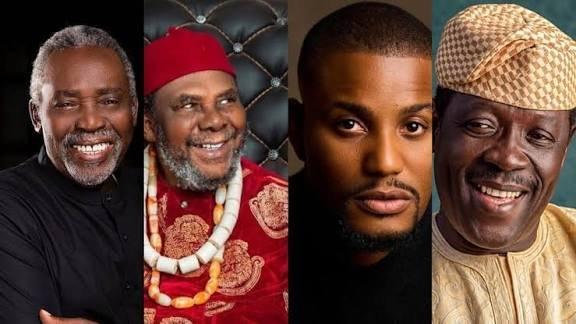
2026 did not just take stars. It took the fathers who gave the industry its voice, the mothers who gave it its heart, and the teachers who gave it its discipline. Pete Edochie is gone. Olu Jacobs is gone. Ogogo is gone. Kola Oyewo is gone. Clarus is gone. Alexx Ekubo is gone. And with each burial, the same fear has returned, whispered in dressing rooms, in viewing centres, in WhatsApp groups, and in the comments under every tribute post: Are there people talented enough to carry their banner?
It is a fair question. It is also an unfair one.
It is fair because what was lost cannot be replaced by imitation. It is unfair because Nollywood has never been carried by one generation alone. It has always been carried forward, often by people nobody saw coming.
To understand the impact, we must first understand what exactly was lost.
What Nollywood lost in 2026 was not just acting talent. It was authority.
When Pete Edochie entered a scene, the audience did not need to be told who was in charge. His voice did it. His posture did it. His silence did it. That authority did not come from social media followers. It came from decades of broadcasting, theatre, and television, from a time when an actor had to earn respect before he could command attention. It came from his early days at the Anambra Broadcasting Service, and from his unforgettable turn as Okonkwo in Things Fall Apart.
Olu Jacobs carried a different kind of authority. It was quiet, cultured, and precise. He represented a bridge between Nigerian theatre and the world, a man who could perform Shakespeare in London and still return home to play a father in a Lagos living room without losing his dignity. His over 50-year marriage to Joke Silva became, for many fans, a quiet lesson in love and partnership.
Kola Oyewo carried the authority of the teacher. He did not just act. He taught acting. He taught history. He taught younger performers that a role was not a costume, but a responsibility. Many who sat in his classes at Obafemi Awolowo University still quote him today.
Davis Offor, as Clarus, carried the authority of familiarity. For millions of Nigerians, he was not a celebrity. He was family. He entered their homes every week on The New Masquerade and became part of their childhood, with his famous costume, his walk, and his humour.
Ogogo carried the authority of Yoruba cinema itself. In his hands, a Yoruba film was not a small film. It was a cultural statement. His deep voice, his proverbs, and his calm delivery made even a simple scene feel like history.
These were not just stars. They were institutions. And institutions are hard to replace.
That is why the impact is being felt in three places at once.
The first is on screen. There is now a visible gap in casting. Nollywood has many young leading men and women, but it has very few older actors who can play a king, a patriarch, a chief, or a village elder with the same weight. When a script calls for a father whose presence alone must silence a room, directors are finding that the list of names they can call is suddenly very short.
The second is off screen. The industry has lost its mentors. The generation that is gone was the generation that corrected young actors on set, that told them to speak clearly, to respect the script, to arrive on time, to understand the character before chasing the camera. Without them, many young actors are learning in public, making their mistakes in front of millions, with no elder to pull them aside.
The third is emotional. The audience has lost its connection to its own past. For many Nigerians, Pete Edochie was not just an actor they watched. He was the voice they heard in their grandfather’s house. Olu Jacobs was the face they saw when they thought of a good father. Ogogo was the voice they heard when they thought of home. When those faces disappear, the audience does not just lose entertainment. It loses memory.
So, are there people talented enough to carry the banner?
The honest answer is yes, but not in the same way.
Nollywood will not produce another Pete Edochie. It should not try. The industry that made Edochie no longer exists. He was made by radio, by theatre, by a time when actors spent years learning before they became famous. Today’s actors are made by a different industry, one shaped by streaming, by Instagram, by YouTube, by cinemas, and by a global audience that watches Nollywood from London, Houston, and Johannesburg.
What Nollywood has now is a different kind of talent. And the mistake we keep making is to forget how many soldiers are still on the field.
Start with Yoruba cinema, because that is where the wound is deepest.
Ogogo is gone. Kola Oyewo is gone. But Odunlade Adekola is still here.
Odunlade did not just watch Ogogo. He acted with him. He learned from him. He inherited his audience, not by copying him, but by building his own language — comedy, tragedy, tradition, and street wisdom in one body. From his early breakout in Asiri Gomina Wa to his later work in Sunday Dagboru, Orisa, and Lisabi, he has shown a rare range. Today, there is no Yoruba film industry without Odunlade. He is the bridge.
Femi Adebayo is still here.
Femi grew up inside the industry. His father, Adebayo Salami, known as Oga Bello, was part of the same generation as the men we just buried. Femi watched that generation up close. He watched how they prepared. How they respected the story. How they treated a set like a shrine. From his law background to his work as a former Special Adviser on Arts and Culture in Kwara State, and to his global hit Jagun Jagun, Femi has always blended discipline with ambition. Today, he is not just an actor. He is a producer, a director, a man who is actively building the next structure.
These two men alone prove the point. The banner did not fall. It was handed over years ago, while the fathers were still alive.
And they are not alone.
Funke Akindele is still here. She started as Jenifa. She became a producer. She became a director. She became a box office force. From I Need To Know to Jenifa, to Omo Ghetto: The Saga, to A Tribe Called Judah, to Everybody Loves Jenifa, she has quietly built one of the most successful production houses in Africa. She employs hundreds. She trains hundreds. She is not waiting for permission to carry Nollywood. She is already carrying it.
Mercy Johnson is still here. From her early days in The Maid to her many roles as a mother, wife, and village girl, she became known for her emotional depth and her work ethic. Iyabo Ojo is still here, from her days as a young actress in Yoruba films to her role today as a producer and mentor to younger stars. Toyin Abraham is still here, from her breakout in Alani Baba Labake to her own box office runs with films like Malaika and Alakada. These are women who learned from the mothers we lost, and who now lead their own sets, their own films, their own audiences.
In English Nollywood, the bridge is just as strong.
Ramsey Nouah is still here, from his early days as a lover boy in Silent Night to his directing work in Living In Bondage: Breaking Free. Richard Mofe-Damijo is still here, from his days as a journalist and actor in Ripples to his commanding presence in The Wedding Party and Shanty Town. Joke Silva is still here, a woman who has acted on stage, on television, and in film for over four decades, and who still speaks with the calm of a teacher. Genevieve Nnaji, who took Nollywood to Netflix with Lionheart, is still here. These are actors who stood shoulder to shoulder with Pete Edochie and Olu Jacobs. They did not just admire them. They shared scenes with them. They took notes. They took corrections. They took blessings.
That is what we lost sight of in our grief. The giants did not die without teaching. They taught in public, for 40 years, on screen, for all of us to see.
Behind them, a new generation is already carrying films on its shoulders. Actors like Timini Egbuson, Stan Nze, Bimbo Ademoye, Uche Montana, and many others are proving that they can hold an audience, not because they copy the old stars, but because they understand the new audience.
It has comedians and content creators who started on Instagram and now fill cinemas. It has Yoruba filmmakers who are telling traditional stories with modern cameras. It has Igbo filmmakers who are telling stories about family, business, and identity in a way that speaks to young Nigerians at home and abroad.
The talent is there. What is missing is time, and structure.
Time, because authority cannot be rushed. Pete Edochie did not become Pete Edochie in one film. He became Pete Edochie over fifty years. The new generation needs the same patience from the audience. It needs to be allowed to fail, to grow, to learn, and to become.
Structure, because talent alone is not enough. The old generation had theatre schools, broadcasting houses, and repertory companies that trained them. The new generation has talent, but it often lacks training. If Nollywood wants to produce the next generation of giants, it must invest in what the giants had: schools, workshops, mentorship, and a system that teaches acting as a craft, not just as fame.
That is the real impact. Not that Nollywood is empty. But that it is suddenly young.
A young industry is fast. It is loud. It is creative. But it can also be careless. Without elders to correct it, it can mistake noise for depth, and fame for craft.
That is the danger. And that is the challenge for Odunlade, Femi, Funke, and the rest of the bridge generation.
They are no longer the children. They are now the elders in the room.
For years, they could say, “Let us ask Baba.” Now, younger actors are asking them.
For years, they could hide behind the giants. Now, they are the ones younger actors look up to.
The question is no longer, “Are they talented enough?” Of course they are talented. Odunlade can carry a film alone. Femi can carry a film alone. Funke can carry a whole cinema weekend alone.
The real question is, “Will they keep teaching like those we buried?”
Because Pete Edochie did not just act. He taught by example. Kola Oyewo did not just act. He taught in classrooms. Ogogo did not just act. He taught by how he treate