
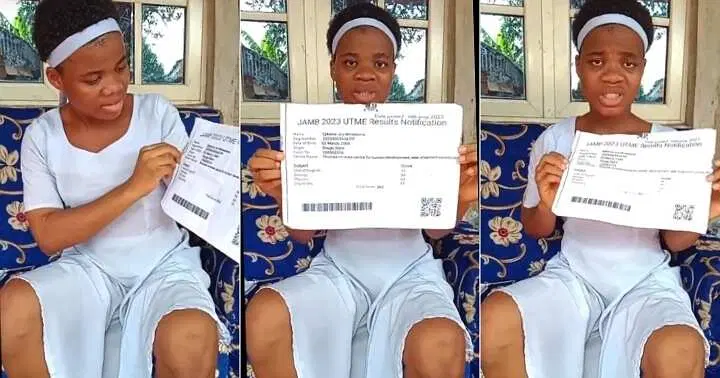
Three years after she became the face of one of Nigeria’s most controversial examination scandals, Anambra student Ejikeme Joy Mmesoma is set to regain eligibility to sit the Unified Tertiary Matriculation Examination (UTME) as the three-year ban imposed on her by the Joint Admissions and Matriculation Board (JAMB) expires this July.
Mmesoma’s case dominated national discourse in July 2023 after she publicly claimed to have scored 362 in the UTME—a result that would have placed her among the highest-performing candidates in the country.
The claim initially attracted widespread sympathy after she alleged that JAMB had refused to recognise her outstanding performance. However, the controversy took a dramatic turn when the examination body declared the result she presented to be fake.
JAMB maintained that Mmesoma’s authentic UTME score was 249, accusing her of manipulating her original result before printing a forged notification slip at a cybercafé. The board insisted that its examination system had not been breached and that the incident was an act of result falsification rather than a technical failure.
According to JAMB, several inconsistencies exposed the forged result. These included discrepancies in the registration number, date of birth, examination centre and the format of the result slip. The board also pointed out that the notification template used on the document had been discontinued since 2021, making it impossible for it to have originated from its official portal.
Despite initially insisting that she printed the result directly from JAMB’s website and denying any wrongdoing, the growing controversy prompted the Anambra State Government to establish an independent panel of inquiry to investigate the matter.
The panel, chaired by Professor Nkemdili Nnonyelu, interviewed JAMB officials, Mmesoma, representatives of her school and other relevant stakeholders before submitting its report.
When the report was released on July 8, 2023, it confirmed JAMB’s position that Mmesoma’s genuine UTME score was 249 and that the 362 score she presented had been manipulated.
The panel further disclosed that Mmesoma admitted during its proceedings that she personally altered the result using her Airtel mobile phone before taking the document to a cybercafé for printing. It concluded that she acted alone, accepted responsibility for her actions and apologised to JAMB, the Anambra State Government and her school.
Following the findings, JAMB withdrew the forged result and imposed a three-year ban, preventing her from participating in any examination conducted by the board.
Announcing the sanction, JAMB’s spokesman, Fabian Benjamin, said the punishment was consistent with the board’s established procedures for examination malpractice and result falsification.
“In the meantime, the management of the Board, after considering the weighty infraction committed by Ms. Ejikeme Joy Mmesoma, and in line with its established procedures, has withdrawn her 2023 UTME result and also barred her from sitting the Board’s examination for the next three years.”
The fallout from the scandal extended beyond JAMB’s disciplinary action.
Innoson Vehicle Manufacturing withdrew the scholarship it had earlier awarded Mmesoma after believing she had achieved one of the highest scores in the examination.
Her father, Romanus Ejikeme, later publicly apologised to JAMB and Nigerians, admitting that his daughter failed to tell him the truth about what had happened.
“My daughter didn’t open up to me on time. When I realised the mistake she did, I blamed her a lot but I’m still apologising to JAMB and Nigerians to pardon her,” he said during an interview with the Nigerian Television Authority (NTA).
Anambra State Governor Chukwuma Soludo also directed that Mmesoma undergo three months of psychotherapy and counselling as part of efforts to support her rehabilitation after the incident.
The controversy generated intense national debate, with politicians, education stakeholders and civil society organisations expressing divergent views.
While some initially criticised JAMB and questioned the integrity of its result verification process, many accepted the board’s position after the state panel confirmed that the result had been manipulated and Mmesoma admitted her role.
The House of Representatives had earlier urged JAMB to suspend the implementation of the ban pending the outcome of investigations, while former Minister of Education Oby Ezekwesili and former Minister of Aviation Osita Chidoka appealed for compassion, counselling and restorative measures rather than prolonged public condemnation.
With the expiration of the three-year sanction this month, Mmesoma is once again eligible to register for the UTME should she decide to pursue admission into a tertiary institution.
Her case remains one of the most significant examination fraud controversies in Nigeria’s recent history and continues to be referenced in discussions on examination ethics, digital result verification, academic integrity and the consequences of falsifying public examination records.