

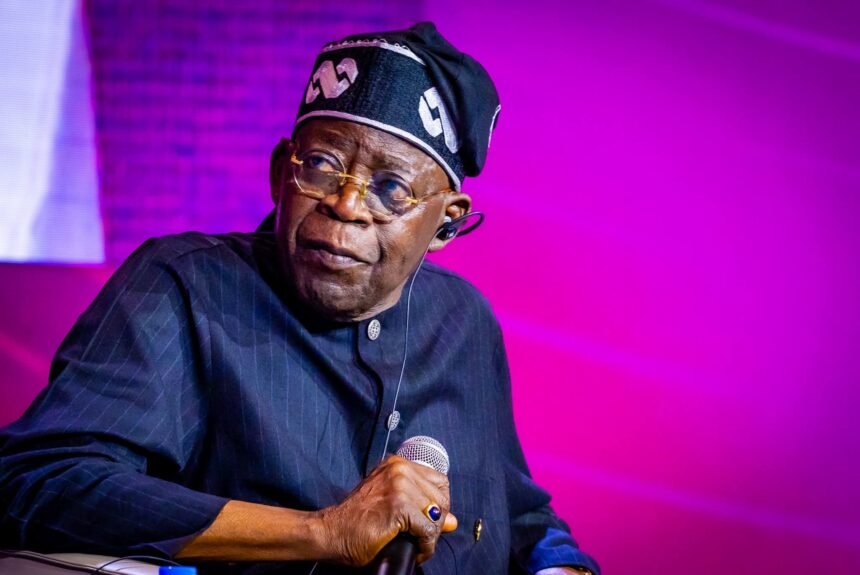
President Bola Tinubu has revealed that he worked as a taxi driver and took up several other jobs in the United States to raise money for his university education, describing his personal struggles as a major influence on his administration’s education policies.
The President said he had to delay his university admission for several months after arriving in the US because he needed time to save enough money to cover his tuition and living expenses.
Tinubu made the disclosure in a message shared on his X handle on Wednesday, November 4, while outlining his administration’s interventions in Nigeria’s education sector.
Recalling his experience as a young student in America, he said the pressure of paying school fees, securing accommodation and meeting other basic needs gave him a personal understanding of the financial difficulties confronting students.
He explained that after eventually getting to Chicago, he combined his studies with different jobs to finance his university education.
The President said those experiences had strengthened his determination to ensure that financial circumstances did not prevent Nigerian children from accessing quality education.
As evidence of his administration’s commitment, Tinubu disclosed that the Nigerian Education Loan Fund (NELFUND) had provided more than N372 billion in loans to students to cover institutional charges and upkeep allowances.
He said the intervention was designed to reduce the financial burden on students and their families while ensuring that young Nigerians could pursue higher education without being forced out of school by financial difficulties.
Tinubu also highlighted developments in technical and vocational education, revealing that the government’s programme had received more than 2.8 million applications, while 38 technical colleges had undergone rehabilitation.
Students in federal and selected state technical colleges, he added, now enjoy free tuition, accommodation, textbooks and uniforms.
On the university system, the President said his administration had reached an agreement with the Academic Staff Union of Universities (ASUU), which provides for a 40 per cent increase in academic staff remuneration and other measures to improve industrial harmony.
He maintained that Nigerian students should no longer spend additional years in universities because of avoidable disruptions, insisting that academic programmes must run according to their approved duration.
“A four-year course must take four years. Our young people deserve to complete their education on time and get on with their lives,” he said.
The President further announced that N110 billion had been committed to rehabilitating 24 medical schools across the country.
He said annual nursing admissions had grown from 28,000 to 115,000, while enrolment in medical and dental programmes had increased from 5,000 to 12,000.
According to him, the expansion is part of efforts to strengthen Nigeria’s capacity to train and retain more healthcare professionals locally.
Tinubu also reported that more than one million children who were previously out of school had returned to classrooms.
He listed teacher development, increased access to education for girls and the introduction of a revised national curriculum that restores Nigerian History to schools among other priorities of his administration.
The President commended the Minister of Education, Dr Tunji Alausa, the Minister of State for Education, Professor Suwaiba Sa’id Ahmad, and other officials for their contributions to the ongoing reforms.
He also introduced an interactive A–Z platform under the Nigeria Education Sector Renewal Initiative (NESRI), encouraging parents, students and teachers to visit edu4pbat.ng to learn about available programmes and opportunities.
Tinubu urged Nigerians to report shortcomings in the education system within their communities, saying public feedback would help the government identify challenges and improve implementation.
He maintained that a child’s family background or circumstances of birth should not determine how far the individual could go academically or professionally.
“Our journey from reform to opportunities and shared prosperity must begin with education,” he said, adding that his administration remained determined to expand opportunities for every Nigerian child.