

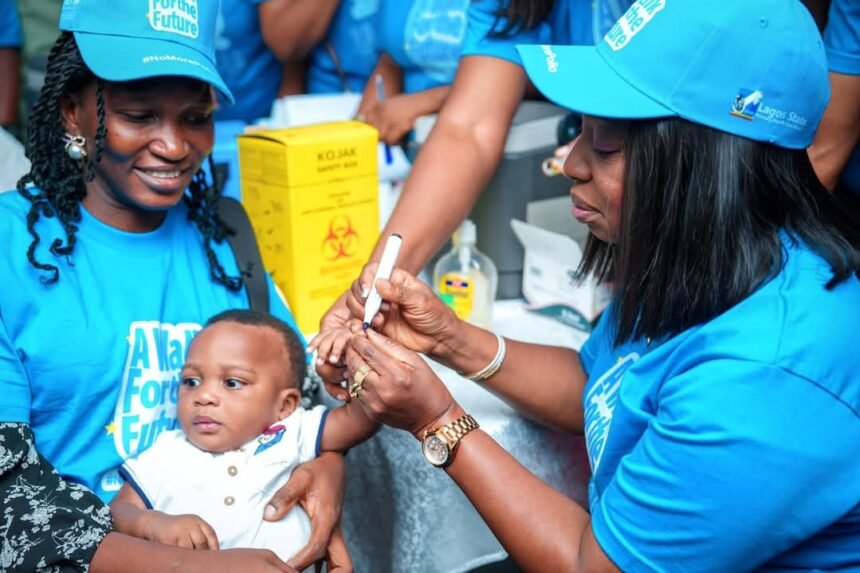
Lagos State allocates about five per cent of its health budget—directly and indirectly—to support immunisation, according to Dr. Ibrahim Mustafa, Permanent Secretary of the Lagos State Primary Health Care Board.
Speaking during an interview to mark World Immunisation Week, Mustafa said routine vaccination in the state is sustained through a combination of federal vaccine supply and state investment in logistics, cold chain systems, and service delivery. He added that efforts are supported by the National Primary Health Care Development Agency and global partners, including WHO, UNICEF, Gavi, and AFENET.
The state currently records an immunisation coverage rate of about 66 per cent. However, Mustafa noted that population influx, vaccine hesitancy, and a high number of “zero-dose” children—those who have not received any routine vaccines—continue to pose major challenges.
He explained that Lagos’ rapid population growth, driven by migration, contributes significantly to the gaps, as many incoming families arrive with children who are either partially vaccinated or not vaccinated at all.
An estimated 120,000 to 130,000 zero-dose children live in Lagos, particularly in underserved areas such as Makoko, parts of Alimosho, and Ikorodu. Alimosho Local Government Area alone accounts for over 35,000 such children—the highest for any LGA in Nigeria.
Mustafa warned that large numbers of unvaccinated children weaken herd immunity and increase the risk of outbreaks of preventable diseases.
To address this, the state has intensified outreach programmes, targeted campaigns, and outbreak response initiatives, while deploying health workers to track and vaccinate missed children.
He also highlighted progress in the rollout of newer vaccines, particularly the Human Papillomavirus (HPV) vaccine for girls aged nine to 14. Despite initial resistance fueled by misinformation—at times leading to hostility against health workers—the state ramped up public engagement through religious leaders, media campaigns, and advocacy by public figures.
As a result, over 1.5 million girls have now received the HPV vaccine, with acceptance rising significantly.
Mustafa credited strong government support, including backing from Governor Babajide Sanwo-Olu, for sustaining immunisation efforts, noting that continued investment and collaboration are essential to closing gaps and protecting public health.
World Immunisation Week, observed from April 24 to 30, highlights the importance of vaccines in saving lives, with this year’s theme: “For every generation, vaccines work.” /NAN