

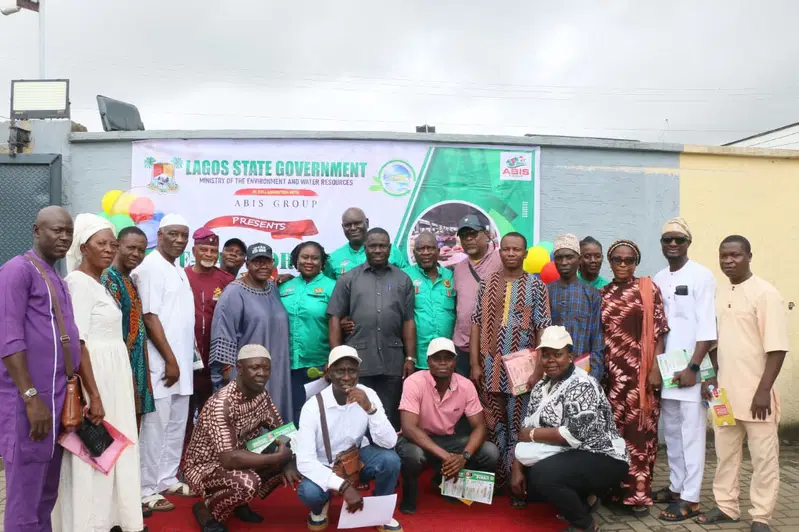
The Lagos State Government has unveiled plans to convert waste generated from abattoirs and slaughterhouses into biogas and organic fertiliser as part of efforts to promote sustainable sanitation and advance the circular economy.
The state government disclosed this on Friday at a one-day workshop for abattoir operators in Ajah, Eti-Osa Local Government Area, organised under the theme, “Red to Green: From Waste Disposal to Resource Recovery.”
The workshop, held at ABIS Farmers Market, Ajah, was organised as part of the state’s waste-to-wealth initiative.
Speaking at the event, the Permanent Secretary, Office of Environmental Services, Ministry of the Environment and Water Resources, Dr Gaji Omobolaji Tajudeen, said the government was shifting its approach from conventional waste disposal to resource recovery.
Tajudeen, who was represented by the Director of Public Sanitation Utility, Mr Rahman Fagbolade, said abattoirs remained important to Lagos’ food system and economy but generated significant quantities of waste.
He listed the waste to include blood, paunch and rumen contents, bones, horns, hooves, faecal matter and wastewater.
He warned that improper management of the materials could lead to environmental pollution, blocked drainage channels, offensive odours and public health risks.
“While enforcement is necessary, sustainable compliance also requires continuous stakeholder engagement, education and capacity building,” he said.
According to him, the workshop was designed to move the conversation beyond conventional waste disposal towards resource recovery and waste-to-wealth opportunities.
He said materials traditionally considered waste could be processed into biogas and organic fertiliser, while bones, horns and hooves could be converted into useful products for other industries.
“When properly segregated, processed and managed, materials traditionally regarded as waste can become valuable resources that support enterprise development, job creation, additional income generation and the growth of a circular economy,” he said.
The permanent secretary identified regulation, education, innovation and collaboration as the four pillars for sustainable waste management in the abattoir sector.
He urged operators to regard compliance not merely as a legal obligation but as an investment in public health, consumer confidence and the long-term sustainability of their businesses.
Tajudeen also encouraged young people to explore opportunities in sustainable environmental management and urged farmers to embrace waste-to-wealth initiatives capable of improving agricultural productivity.
He described the transition from “Red to Green” as a fundamental change in the way waste is perceived and managed.
“It seeks to transform waste from an environmental burden into a valuable resource, a disposal challenge into an economic opportunity,” he said.
He urged participants to implement the recommendations from the workshop, stressing that the success of the initiative would depend on actions taken after the event.
“The true measure of success for this initiative will not be today’s discussions alone, but the actions we take afterwards in our abattoirs, slaughterhouses, farms, businesses and communities,” he said.
The state government expressed optimism that the initiative would contribute to cleaner abattoirs, improved sanitation and a stronger circular economy across Lagos.
In a guest lecture titled “From By-products to Business: Unlocking the Economic Value of Bones, Horns, Hooves and Other Abattoir By-products,” Mr Muyiwa Semowo highlighted the economic potential of materials generated from abattoir operations.
Semowo said such materials could be processed into valuable products for industries including agriculture, manufacturing, pharmaceuticals, cosmetics and animal feed.
He urged abattoir operators to adopt proper segregation, handling and processing methods to improve the quality and market value of the by-products.
According to him, embracing a circular economy approach would help reduce environmental pollution, improve sanitation around abattoirs, create new businesses, generate employment and increase operators’ incomes.