
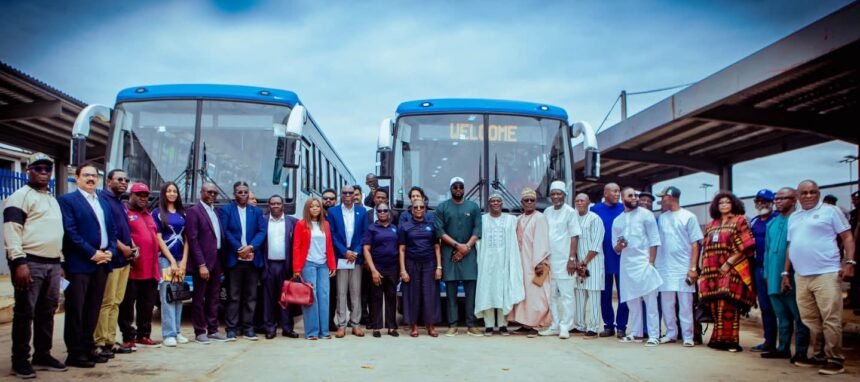
The transformation of public transportation in Lagos State has entered a new phase with the deployment of Compressed Natural Gas (CNG) buses by Amalgamated Megacity Transport Services Limited, reflecting increased private-sector participation in the state’s drive towards a cleaner, more efficient and sustainable transport system.
The deployment marks another milestone in the implementation of the Lagos State Bus Industry Transition Programme (BITP), which encourages transport operators to invest in modern, high-capacity buses and adopt cleaner energy alternatives.
Commissioner for Transportation, Mr Oluwaseun Osiyemi, described Amalgamated’s investment as a demonstration of confidence in the future of public transportation in Lagos and the state government’s commitment to cleaner mobility.
He explained that Lagos’ transportation reform agenda extends beyond road transport to include rail, Bus Rapid Transit (BRT), Quality Bus Corridors, interchanges and waterways. These components are being developed as part of an integrated, multimodal network designed to improve connectivity and provide residents with more efficient transport options.
According to Osiyemi, CNG is an important transitional technology in Lagos’ clean-mobility drive, rather than the ultimate destination. The state’s long-term objective is to gradually move from conventional fossil-fuel-powered transport towards low-emission and eventually zero-emission mobility, particularly through electric buses and other emerging technologies.
The strategy is intended to ensure that buses, rail services, waterways and electric mobility solutions complement one another while reducing emissions and dependence on conventional fossil fuels.
Speaking at the event, the Managing Director and Chief Executive Officer of the Lagos Metropolitan Area Transport Authority (LAMATA), Engr. Mrs Abimbola Akinajo, said Amalgamated had been engaged from the outset with the expectation that transport operators would invest in their own fleets, with particular emphasis on cleaner technologies such as CNG and electric vehicles.
She disclosed that the company had committed to acquiring 50 CNG buses, of which 15 had been delivered, while the remaining 35 were expected before the end of 2026.
Akinajo said the investment demonstrated that the transition to cleaner mobility was moving beyond government policy and gaining traction among private transport operators.
“This is the direction we expect the industry to go,” she said, underscoring the need for operators to take greater responsibility for fleet renewal and investment in the future of public transportation.
The development comes as Lagos continues to grapple with rising population, expanding economic activity and growing demand for public transport.
Akinajo disclosed that the state requires approximately 15,000 high-capacity buses to meet its transportation needs, alongside rail and water transport services that form part of its integrated mobility network.
She stressed that meeting this demand would require sustained collaboration between the government and private investors, given the scale of the resources needed to expand and modernise the transport system.
LAMATA, she said, remained committed to creating an enabling environment for transport operators to invest, innovate and deliver improved services to commuters. However, private-sector participation remains essential to closing the gap between existing capacity and the state’s growing transportation needs.
The deployment of Amalgamated’s CNG buses therefore represents more than an addition to Lagos’ public transport fleet. It also reflects an evolving bus industry in which private operators are increasingly expected to invest in modern vehicles and work alongside the government to deliver a more efficient, accessible and sustainable transportation system.