
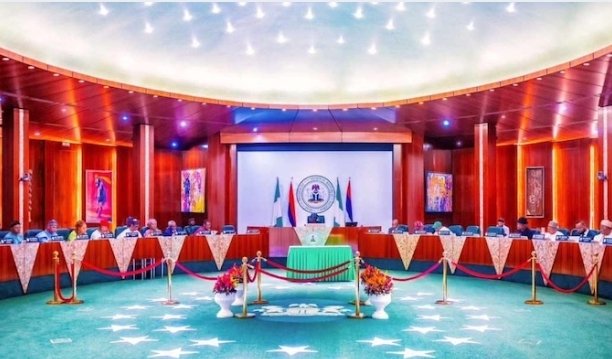
The Federal Executive Council (FEC) on Thursday approved over ₦2.5 trillion for sweeping infrastructure investments across Nigeria, spanning aviation, road transport, electricity, education, and health.
At the centre of the announcements was a ₦712 billion approval for the complete overhaul of Terminal One at Murtala Muhammed International Airport (MMIA), Lagos, under a broader ₦900 billion aviation masterplan.
Addressing journalists after the meeting chaired by President Bola Tinubu at the State House, Minister of Aviation and Aerospace Development, Festus Keyamo, said the Lagos terminal would be stripped down to its structural core and rebuilt with modern mechanical, electrical, and plumbing systems. The 22-month project will be executed by China Civil Engineering Construction Corporation (CCECC) and fully funded by the Renewed Hope Infrastructure Development Fund.
“We have decided to strip it down to only the carcass and then do the complete M&E again,” Keyamo said, highlighting a shift from patchwork fixes to full-scale rehabilitation.
FEC also approved the expansion of Terminal Two, including a new apron, access roads, and bridges—bringing the total Lagos airport investment to ₦712.26 billion, the largest single intervention in Nigeria’s aviation sector in recent memory.
To address security challenges at MMIA, the council greenlit a ₦49.9 billion perimeter fence project featuring CCTV, solar floodlights, intrusion detection systems, and a modern command centre capable of real-time surveillance.
Other Key Aviation Approvals:
- Malam Aminu Kano Int’l Airport: ₦46.39 billion to rehabilitate runways and taxiways and upgrade airfield lighting to CAT 2 standard (24-week timeline).
- Port Harcourt Int’l Airport: ₦42.14 billion for similar upgrades.
- Lagos Airport Runways 18L/36R and Taxiways B and C: ₦44.13 billion for CAT 2 LED lighting (30-week project).
- Domestic Wing, Lagos: ₦24.27 billion for apron reconstruction and expansion (82,000 sqm over 17.5 months).
- Enugu Airport Concession: FEC approved a full business case for a 30-year private concession of Akanu Ibiam Int’l Airport, including cargo terminal development.
Keyamo said the concession plan aimed to relieve financial pressure from underperforming airports and unlock non-aeronautical revenue opportunities such as malls and conference centres.
“The unions have been involved from the beginning. Full transparency will guide every step,” he assured.
Power Sector: ₦213.7 Billion for Universities, Hospitals, and Rural Electrification
Minister of Power, Adebayo Adelabu, announced the approval of two major projects to expand energy access:
- ₦145 billion Energising Education Programme (EEP) – For renewable power in universities and teaching hospitals, including UNILAG, ABU Zaria, OAU, UNN, UI, and UCH Ibadan. Funded through the Renewed Hope Infrastructure Development Fund.
- ₦68.7 billion Agricultural Centres of Excellence Project – For solar infrastructure in rural communities and agribusiness clusters. Timeline: 3 months.
Adelabu said the projects build on previous REA efforts and will tackle persistent blackouts, reduce energy costs for institutions, and support agricultural productivity.
“No Nigerian will be left behind in the power transformation,” he said.
Roads and Bridges: Over ₦1.6 Trillion for Key Transport Corridors
Minister of Works, Senator Dave Umahi, announced a raft of approvals and variations for strategic road projects, including:
- Abuja–Kano Road: ₦220 billion (30% disbursed)
- Enugu–Onitsha Road: ₦150 billion (₦45bn released)
- Port Harcourt–Bonny Road: ₦200 billion, nearing completion
- Akure–Ado-Ekiti Road: ₦761 billion (30% disbursed)
- Lagos–Calabar Coastal Highway Sections 4A & 4B: ₦1.65 trillion (Ogun & Ondo, 80.35 km x2)
- Sokoto–Badagry Superhighway:
- Kebbi Section: 258 km x2 at ₦1.92 trillion
- Sokoto Section: 120 km x2 at ₦912 billion
He also confirmed that reconstruction had begun on the collapsed Keffi Flyover in Nasarawa State, following the tragic deaths of three people in July.
“We’ve settled with the families, and we’ve commenced work to prevent further disasters,” Umahi said.
He highlighted that 360 road projects were completed in 2023, with engineering chambers and stakeholders now involved in monitoring.
Health Sector: UCH Ibadan Oncology Centre and More
Coordinating Minister of Health, Prof. Muhammad Ali Pate, announced the approval for the upgrade of the Oncology Centre at UCH, Ibadan, with new radiotherapy and diagnostic systems, including linear accelerators.
The facility joins other comprehensive cancer centres already launched in Katsina, Enugu, and Jos, with new ones planned for Lagos and Zaria.
“Cancer patients now have access to world-class care within Nigeria,” Pate said.
He highlighted ongoing reforms at the University of Abuja Teaching Hospital, which now houses state-of-the-art centres for neurology, cardiology, and stroke treatment.
On labour relations, Pate acknowledged concerns over recent salary circulars but assured that the matter had been resolved and negotiations on revised allowances were underway with key unions.
Conclusion: Renewed Hope in Action
From airports and universities to roads and hospitals, the Thursday FEC meeting marked one of the boldest statements yet of the Tinubu administration’s infrastructure agenda, with over ₦2.5 trillion in project approvals—most of it focused on long-neglected sectors.
“We are building for the future—not just patching the past,” said Keyamo, summarising the government’s long-term vision.