

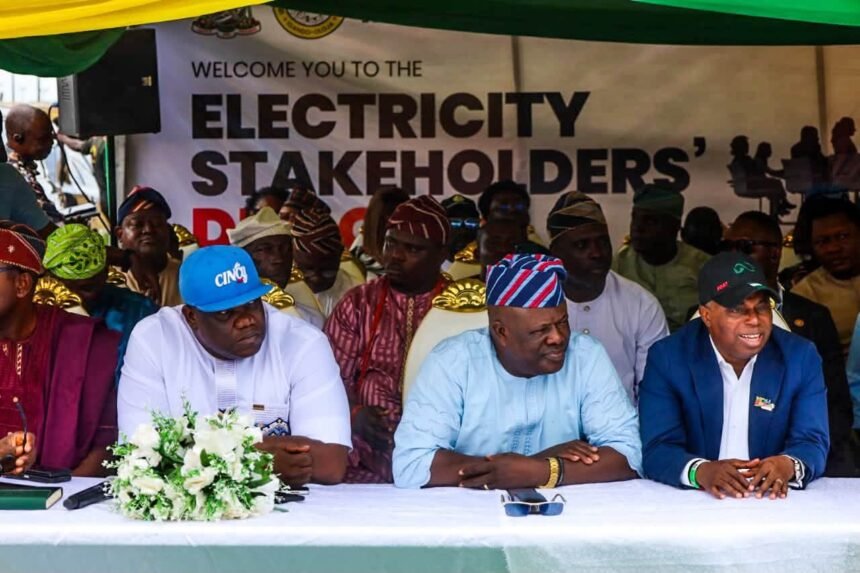
The Lagos State Government has reaffirmed its commitment to addressing the longstanding electricity challenges in Ibeju-Lekki through major power infrastructure projects and reforms.
The Commissioner for Energy and Mineral Resources, Biodun Ogunleye, gave the assurance at an electricity stakeholders’ dialogue hosted by the Executive Chairman of Ibeju-Lekki Local Government and Chairman of Conference 57 Lagos, Abdullahi Sesan Olowa.
Ogunleye said the state was taking a holistic approach to developing the Lekki-Epe and Ibeju-Lekki corridor, where rapid residential, industrial and commercial growth has increased the demand for reliable electricity.
He identified the ongoing 132kV transmission line from the Ajah Power Substation to Eleko Junction as one of the key projects expected to address the power supply challenges in the area.
According to him, the project is being implemented through collaboration between the Lagos and Federal Governments, with the contractor already mobilised and work at an advanced stage.
He said the transmission infrastructure would improve the capacity to evacuate and distribute electricity to Ibeju-Lekki, Akodo, Eleko and adjoining communities, while complementing existing and proposed power generation and gas infrastructure.
The commissioner also listed other major infrastructure projects planned or ongoing in the corridor, including the Purple Line rail extension, service lanes, telecommunications infrastructure and gas pipeline development.
He said the establishment of the Lagos State Electricity Regulatory Commission (LASERC) and Lagos State Independent System Operator (LAISO) would provide the institutional framework for regulating and coordinating the evolving electricity market.
At the meeting, Surveyor Adeola Amokaye presented the proposed Right-of-Way alignment for the Ajah-Eleko transmission project and highlighted its interface with existing roads, drainage systems, gas pipelines, telecommunications infrastructure and properties.
Areas requiring further assessment and stakeholder engagement included Abraham Adesanya, Lagos Business School, the Shongunle/Shoprite axis and Abijo.
Residents and other stakeholders raised concerns about potentially affected properties and called for continued engagement as the project progresses.
Ogunleye assured them that the government would explore options to minimise disruption while ensuring the delivery of critical infrastructure.
He said the objective was to achieve a balance between public infrastructure requirements and the legitimate interests of residents, communities and businesses.
The member representing Ibeju-Lekki Federal Constituency in the House of Representatives, Bayo Balogun, commended the initiative and called for stronger collaboration among the Federal Government, Lagos State Government, local authorities, electricity-sector institutions and host communities.
He also urged the council chairman to establish a committee to interface with the state government and relevant agencies and ensure that community concerns are addressed.
Olowa, in his remarks, reaffirmed the local government’s commitment to working with the state government and other stakeholders to resolve the area’s electricity challenges and support the broader development of the corridor.
The dialogue ended with an interactive session where residents sought clarification on electricity supply, the transmission project, Right-of-Way requirements, affected properties and other infrastructure projects in Ibeju-Lekki.