
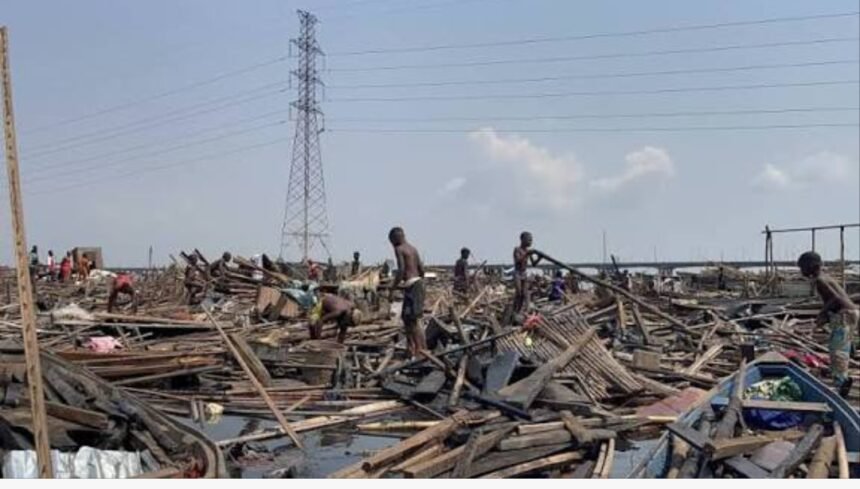
The Coalition for Good Governance (CGG) has called for sincerity from all stakeholders in the ongoing controversy surrounding recent demolitions in Makoko, urging the Lagos State Government to fully implement its urban development plans for the area to avert potential disasters.
Addressing journalists in Lagos on Wednesday, the coalition said it had observed with concern the blame game between the state government and residents of the waterfront settlement over the demolition of structures erected under high-tension power lines.
CGG noted that Makoko has remained a recurring site of demolitions by successive administrations, recalling similar exercises carried out in 2005 and 2012 to address safety and environmental concerns. The group described the community as one of Lagos’ most controversial urban spaces, often cited by city planners as evidence of longstanding planning and regulatory challenges.
According to the coalition, Makoko’s estimated population of between 80,000 and 250,000 residents live largely in stilted wooden structures over the Lagos Lagoon, with limited access to sanitation, potable water, electricity and proper waste management. It added that many residents depend on artisanal fishing and informal trade, making them economically vulnerable.
While acknowledging the humanitarian impact of the demolitions on affected families, CGG maintained that concerns raised by the government — including building under high-tension power lines, flooding, fire risks and unplanned construction — are valid from a regulatory and public safety standpoint.
The coalition said that based on its findings, the state government had previously engaged community leaders in dialogue and reached an agreement for residents to voluntarily remove structures violating approved safety distances from high-tension lines. However, it alleged that the residents failed to fulfill their part of the agreement, prompting the government to enforce compliance.
The recent demolitions have sparked anger within the community, with some residents accusing the government of acting outside the agreed terms. CGG, however, questioned which side had adhered to the understanding reached, stressing that government has a constitutional duty to protect lives and ensure public safety.
The group commended the Lagos State House of Assembly for intervening by constituting a committee of stakeholders and ordering a temporary suspension of the demolitions to ease tensions. It also welcomed the state government’s pledge to enumerate affected properties and handle the matter with what it described as “a human face.”
As part of its demands, CGG called for the immediate implementation of a comprehensive urban development programme for Makoko to prevent avoidable disasters. It also urged Governor Babajide Sanwo-Olu not to relent in enforcing safety measures in the area, arguing that proactive evacuation and compliance would be preferable to potential loss of lives in the event of a high-tension power line accident.
The coalition further demanded greater sincerity, transparency and trust among all parties in future engagements, noting that past interactions appeared to have been undermined by communication gaps and conflicting interests.
The press conference was jointly signed by Nelson Ekujumi, Razaq Oladosu, Peter Oparah, Rotimi Falola, Uche Nnadozie, Elijah Ajanu, Shola Omolola, Biola Ogunsanya and Shafiu Mohammed on behalf of the coalition