
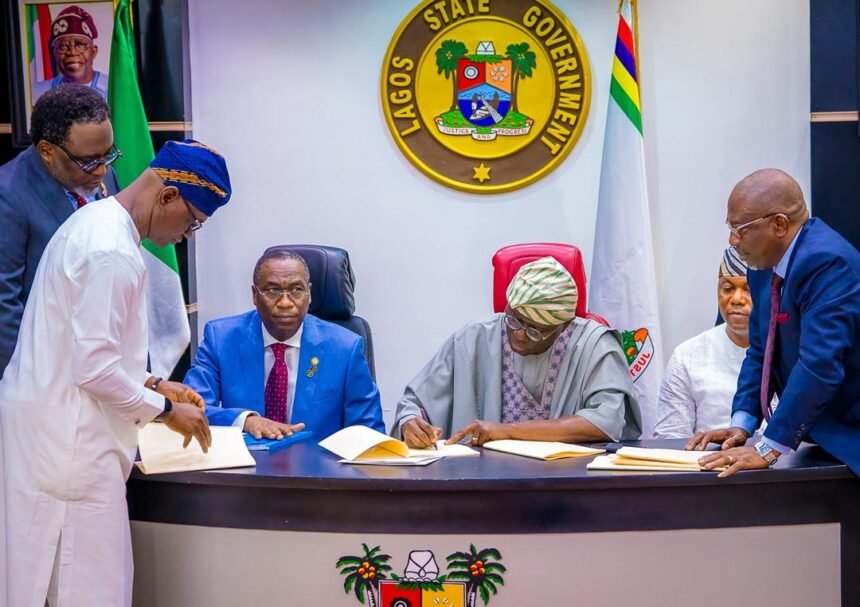
Lagos State Governor, Mr. Babajide Sanwo-Olu, on Monday signed the State’s 2026 Appropriation Bill, tagged the “Budget of Shared Prosperity,” into law, formally approving a spending plan of N4.444 trillion for the year.
The signing ceremony took place at Alausa, Ikeja, following the passage of the budget by the Lagos State House of Assembly on January 8 and its subsequent transmission to the Executive for assent.
Speaking at the event, Sanwo-Olu said the 2026 budget underscored his administration’s commitment to strengthening governance, sustaining the state’s competitiveness and repositioning Lagos for inclusive growth. He described the document as an inclusive fiscal framework designed to impact residents across all sectors and communities of the state.
The governor acknowledged that Lagos entered the year facing significant governance challenges, citing the recent fire outbreak at Balogun Market on Lagos Island and the ongoing demolition of shanties along the Ebute Metta waterfront. According to him, these challenges highlighted the urgent need for improved infrastructure and enhanced service delivery.
Sanwo-Olu said the budget would focus on key priority areas, including education, healthcare, security and infrastructure development, with plans to construct new schools and health facilities while strengthening security services to keep Lagos safe for residents and businesses.
He assured Lagosians of responsible implementation, stressing that the government would ensure accountability and value for money. “In the end, Lagosians will feel the impact of the efforts made by both the Executive and the House of Assembly,” the governor said.
The governor added that the 2026 fiscal year would place strategic emphasis on infrastructure renewal, transportation expansion, agricultural development and other growth-enhancing initiatives aimed at boosting productivity, supporting micro, small and medium-scale enterprises (MSMEs), creating jobs and driving broad-based economic growth.
Sanwo-Olu also condemned indiscriminate waste disposal across the state, describing it as unacceptable, and called on residents to take greater responsibility in protecting the environment. He said the state government would double the capacity of the Lagos State Waste Management Authority (LAWMA) and private waste operators to improve waste management.
Earlier, the Commissioner for Economic Planning and Budget, Mr. Ope George, said the 2026 Appropriation Law reflected the government’s deliberate efforts to promote a more resilient and people-centred governance structure. He described the budget as a bold and disciplined fiscal response to prevailing economic realities.
George disclosed that the budget was reviewed upward from an initial N4.2 trillion proposal after legislative scrutiny and engagements with Ministries, Departments and Agencies. He explained that the expenditure framework comprises N2.337 trillion for capital expenditure, representing 53 per cent, and N2.107 trillion for recurrent expenditure, accounting for 47 per cent.
He expressed confidence in the successful implementation of the budget, noting that the strong performance of the 2025 budget provided a solid foundation for 2026.
The Speaker of the Lagos State House of Assembly, Rt. Hon. Mudashiru Obasa, represented by the Majority Leader, Hon. Noheem Adams, said the legislature subjected the budget to thorough scrutiny to ensure it reflected the aspirations of Lagos residents.
Adams said the House was confident in the Executive’s capacity to implement the budget as approved.